Rigol Vs Keysight: In-depth Comparison For Test And Measurement Equipment
When engineers, technicians, and electronics hobbyists talk about test and measurement equipment, two brands come up repeatedly: Rigol and Keysight. Both companies offer a wide range of instruments such as oscilloscopes, signal generators, spectrum analyzers, and multimeters. While both have strong reputations, their products can differ in important ways. Choosing the right brand can impact your work quality, budget, and even how much you enjoy using your lab equipment.
It’s easy to get lost in technical details or marketing claims. This guide breaks down what really matters, from performance and price to software, support, and hidden costs. Whether you’re setting up a new lab, upgrading your tools, or just curious about these two giants, you’ll find clear answers here.
Brand Backgrounds
Understanding where each brand comes from helps explain their strengths and weaknesses.
Keysight Technologies has a long history. It was originally part of Hewlett-Packard (HP), then Agilent Technologies, and finally became Keysight in 2014. This company is known for high-end, reliable instruments. Many industry professionals trust Keysight for research, aerospace, and advanced electronics.
Rigol Technologies started in 1998 in Beijing, China. Rigol began by offering affordable oscilloscopes and quickly gained popularity among hobbyists and small businesses. Today, Rigol is a respected global brand, offering more instruments with features that once cost much more.
Both companies have expanded their product lines and compete in similar markets. However, their design philosophies and customer focus are sometimes very different.
Main Product Categories Compared
To understand the differences, let’s compare their main product lines.
Oscilloscopes
Oscilloscopes are the “eyes” of electronics labs. Both Rigol and Keysight offer entry-level and advanced models.
Entry-level Oscilloscopes
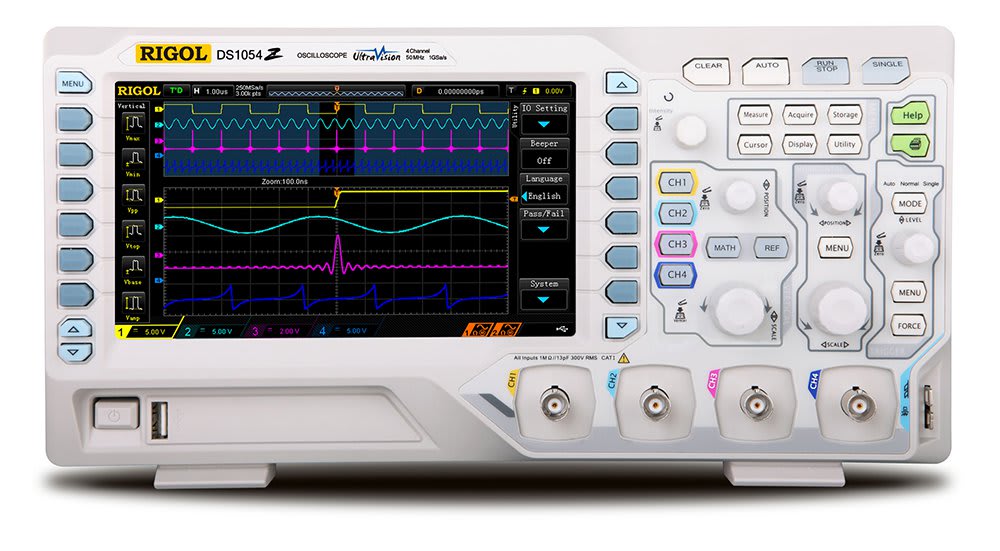
Rigol’s entry-level DS1000Z series has set a high standard for affordability and features. It includes models like the DS1054Z with 50 MHz bandwidth, 4 channels, and a 7-inch display. Many students and engineers consider it the best value under $400.
Keysight’s comparable models, like the InfiniiVision 1000 X-Series, offer similar bandwidth but usually cost more—often $650-$900 for a 4-channel model. However, Keysight’s instruments are known for better build quality, smoother controls, and a more polished user experience.
Rigol’s advantage is price and good-enough performance for many tasks. Keysight’s advantage is better signal fidelity, deeper memory, and more responsive operation.
Mid-range And Advanced Oscilloscopes
As you move up, both brands offer more bandwidth, higher sampling rates, and advanced features.
For example:
- Rigol MSO5000 series: 70 MHz to 350 MHz bandwidth, 8 GSa/s sample rate, large 9-inch touch display.
- Keysight InfiniiVision 3000T X-Series: 100 MHz to 1 GHz bandwidth, up to 5 GSa/s, and similar touch screen controls.
Keysight’s higher-end models often have better signal accuracy and lower noise. They also usually support more advanced analysis software. However, Rigol’s mid-range models have closed the gap, especially with their newer user interfaces.
Spectrum Analyzers
Spectrum analyzers are essential for RF work, wireless communication, and EMC testing.
Rigol’s RSA3000 series offers real-time analysis, up to 3 GHz bandwidth, and modern touch screens at prices starting around $3,000. These units are popular for university labs and startups.
Keysight’s N9000A CXA is a well-known entry-level spectrum analyzer, but its price starts much higher (often $10,000 or more). Keysight’s instruments generally offer higher sensitivity, better phase noise, and advanced features like vector signal analysis.
For basic use, Rigol delivers good value. For demanding professional work, Keysight’s performance can justify the higher price.
Signal Generators
Signal generators are used for testing and simulating signals in circuits.
Rigol’s DG900 series provides up to 100 MHz output, dual channels, and 16-bit vertical resolution for less than $1,000.
Keysight’s 33500B series offers similar specs but at higher prices—often $2,000 or more. Keysight’s units are known for very low distortion, precise frequency control, and excellent reliability.
For most education and light industry needs, Rigol’s models are sufficient. Keysight is often chosen for research, communications, and production testing.
Digital Multimeters
Rigol’s DM3000 series and Keysight’s 34460A/34461A series are popular bench multimeters.
Keysight’s meters are famous for their accuracy, stability, and advanced features like data logging and remote control. Rigol’s meters are generally less expensive and still offer good accuracy for everyday lab work.
Feature Comparison
Many buyers focus only on bandwidth or channel count, but other features matter too.
User Interface And Controls
Keysight’s instruments usually have more intuitive menus, faster response times, and higher quality buttons and knobs. Their displays often have better contrast and touch response.
Rigol’s interfaces have improved a lot, especially in new models. Still, some users find menu navigation slower or less logical.
Software And Connectivity
Both brands provide PC connectivity, remote control, and data logging software.
- Keysight: Advanced software suites (like BenchVue), easy integration with lab automation, and strong support for SCPI commands.
- Rigol: Basic software included, with options for more advanced analysis. Some users report connection issues or limitations compared to Keysight.
A key insight: Rigol’s open communication protocol allows easy scripting for custom automation, which is a plus for DIY users.
Firmware And Upgrades
Rigol is famous (and sometimes controversial) for “unlockable” features. For example, bandwidth upgrades and advanced analysis options can sometimes be enabled with a code. This has led to a community of users who hack their scopes to unlock features.
Keysight sells upgrades as paid licenses, and firmware is more locked down. This means you must plan your purchase carefully to avoid missing key options.
Performance: Accuracy, Speed, And Reliability
Measurement Accuracy
Keysight’s instruments are usually specified with tighter accuracy, especially in higher-end models. For example, a Keysight bench DMM might be accurate to 0. 0035% of reading, while Rigol is closer to 0. 01%.
In oscilloscopes, Keysight often has lower noise floors and better signal fidelity. This can be critical for measuring very small signals or high-frequency waveforms.
Update Rate And Responsiveness
Keysight’s oscilloscopes typically have higher waveform update rates (e. g. , over 1 million waveforms/sec in some models). This makes them better at capturing rare glitches and seeing real-time events.
Rigol’s update rates are generally lower, though newer models have improved. For most non-critical work, Rigol’s speed is enough.
Build Quality And Longevity
Keysight’s instruments are known for rugged construction. Buttons, knobs, and connectors feel solid and last years under heavy use. Many Keysight products are still working after 10 or 20 years.
Rigol’s build quality is good for the price, but you may notice lighter cases, cheaper feeling buttons, or less robust connectors. For heavy industrial use, Keysight will likely last longer. For hobby or school labs, Rigol holds up well.
Price And Value
Here is a side-by-side price comparison of typical entry-level models:
| Product | Rigol Price (USD) | Keysight Price (USD) | Bandwidth/Key Specs |
|---|---|---|---|
| Oscilloscope | ~$350 (DS1054Z) | ~$700 (DSOX1102G) | 50 MHz, 4 channels |
| Spectrum Analyzer | ~$3,000 (RSA3030) | ~$10,000 (N9000A CXA) | 3 GHz |
| Signal Generator | ~$700 (DG952) | ~$2,000 (33511B) | 50 MHz, 2 channels |
Rigol wins on price almost every time. For basic specs, you often pay half or less compared to Keysight.
But, if you need the highest reliability, compliance with industry standards, or advanced features, Keysight’s higher cost may be justified.
Support And Warranty
Technical Support
Keysight has a global support network, with local offices, fast email and phone help, and engineers who know the products deeply. They also offer calibration and repair services worldwide.
Rigol’s support is improving, especially in North America and Europe. However, it can be slower, and getting help for advanced problems may be more difficult.
Warranty
Keysight typically offers 3-year warranties on most instruments, with options to extend. Rigol usually offers 3 years as well, but the process may involve shipping to another country.
One insight: If you are a small business, fast and easy support can be more valuable than a low price.
Community And Ecosystem
User Community
Rigol has a strong online community, especially among makers and hobbyists. You can find many tutorials, hacks, and tips on YouTube and forums.
Keysight’s community is more focused on professional users. There are fewer “hacks,” but more official application notes and white papers.
Accessories And Options
Keysight offers more official accessories, like high-voltage probes, advanced trigger modules, and rack-mount kits. Rigol’s accessories are basic but usually included in the box.
Common Buyer Mistakes
Many first-time buyers focus only on the headline specs—bandwidth, channels, sample rate—without considering the following:
- Missing Features: Some advanced features (like serial bus decoding or waveform generators) are optional or require extra payment, especially with Keysight.
- Ignoring Software Limitations: Not all software is equally good. Check if the instrument works with your computer or automation scripts.
- Underestimating Support Needs: If you rely on fast repairs or calibration, consider the brand’s local presence.
- Overbuying: Paying for high-end features you never use is a common waste, especially with expensive models.
- Assuming All Accessories Are Included: Sometimes you must buy probes or adapters separately, which can add to the cost.

Credit: www.batterfly.com
When To Choose Rigol
Rigol is a smart choice if:
- You are on a tight budget.
- You are a student, maker, or small business needing good general-purpose tools.
- You value feature-packed instruments at a low price.
- You don’t require the absolute best accuracy or support.
Rigol is also ideal for labs where equipment might be handled by many people and occasional damage is not a disaster.
When To Choose Keysight
Keysight is the better choice when:
- Reliability and accuracy are critical (e.g., aerospace, research, compliance testing).
- You need advanced features, deep memory, or specialized analysis.
- You value local support, fast calibration, and long-term service.
- Your organization requires compliance with industry standards.
Keysight is also the industry standard for many test labs, so their equipment often holds higher resale value.
Real-world User Experiences
Let’s look at some real feedback from users.
- University Labs: Many universities use Rigol for teaching labs, but keep a few Keysight instruments for advanced research. This saves money while still offering top performance when needed.
- Small Businesses: Startups often start with Rigol gear, then add Keysight equipment as they grow and need better support or compliance.
- Hobbyists: Many hobbyists say Rigol’s DS1054Z “does everything I need,” but those who move into RF or high-speed work often upgrade to Keysight.
- Service Labs: Repair shops and service centers tend to choose Keysight for its durability and fast, reliable support.
Future Trends
Rigol is closing the feature gap quickly. Their new models have touch screens, deeper memory, and faster processors. Keysight continues to push innovation, especially in software and automation.
A future insight: As open-source software and remote labs become more popular, brands that support easy connectivity and scripting will win more users.

Credit: revinetech.com
Side-by-side Feature Comparison
Here is a summary table comparing typical features for entry-level oscilloscopes:
| Feature | Rigol DS1054Z | Keysight DSOX1102G |
|---|---|---|
| Bandwidth | 50 MHz (upgradeable to 100 MHz) | 70 MHz (options for 100 MHz) |
| Channels | 4 | 2 |
| Sample Rate | 1 GSa/s | 2 GSa/s |
| Waveform Update Rate | 30,000 wfms/s | 50,000 wfms/s |
| Display | 7″ color | 7″ color |
| Serial Decode | I2C, SPI, UART (options) | I2C, SPI, UART (options) |
| Warranty | 3 years | 3 years |
Non-obvious Insights
- Upgrade Paths Matter: Rigol’s ability to unlock features later (sometimes unofficially) can be a huge cost saver, but may void warranties or cause software issues. Keysight’s upgrades are official, but often expensive.
- Resale Value: Keysight instruments hold value better, so if you plan to upgrade in the future, you may recover more of your investment.
- Noise and Crosstalk: In crowded circuits or sensitive analog work, Keysight’s lower noise and crosstalk can make a real difference—even if the specs look similar on paper.
Which Brand Wins Overall?
There is no universal winner. For value and features, Rigol is hard to beat, especially for learning, prototyping, and general use. For performance, reliability, and support, Keysight remains the gold standard for professionals.
The best strategy for many labs is to mix both brands: use Rigol for routine tasks and Keysight for demanding measurements.
If you want to explore more about test equipment standards and reviews, you might find the resources at Wikipedia useful.
Frequently Asked Questions
What Are The Main Differences Between Rigol And Keysight?
Keysight is known for professional-grade, high-reliability instruments with advanced features and strong support. Rigol focuses on affordable, feature-rich tools for education, hobbyists, and startups. Keysight often has better accuracy and durability, while Rigol offers more for your money.
Is Rigol Good Enough For Professional Use?
For many applications, yes. Rigol’s newer instruments are widely used in universities, R&D, and small businesses. However, for the most demanding or regulated tasks, Keysight is still preferred.
Can I Unlock Extra Features On Rigol Instruments?
Many Rigol devices can be upgraded with software codes to unlock extra bandwidth or analysis tools. This is unofficial and may void the warranty. Keysight upgrades are official but usually cost more.
How Does Support Compare Between Rigol And Keysight?
Keysight offers faster, more reliable global support, with local offices and experienced engineers. Rigol’s support is improving but can be slower, especially for advanced issues or outside major markets.
Which Brand Is Better For Beginners?
Rigol is often best for beginners due to its lower cost and good feature set. It’s easier to experiment without worrying about damaging an expensive instrument. Keysight is better if you plan to use the equipment for many years or need advanced support.
Choosing between Rigol and Keysight is not just about specs—it’s about your needs, budget, and long-term goals. Both brands have their place in the modern electronics lab. If you weigh the factors described above, you’ll make a confident, informed decision.
Credit: www.tequipment.net