When it comes to oscilloscopes, two names often stand out: Rigol and Tektronix. Both brands have earned reputations in electronics, education, and industry, but they serve slightly different needs and budgets. Whether you are a student, hobbyist, or working engineer, understanding the differences between Rigol and Tektronix can help you make a smart decision for your next test equipment purchase. This detailed guide will walk you through their histories, core product lines, user experiences, strengths, weaknesses, and what to consider before buying.
The Background: Rigol And Tektronix
Rigol and Tektronix have very different backgrounds and journeys in the electronics world.
Rigol is a Chinese company, founded in 1998. In just a few decades, it has become a global player, well-known for making affordable, feature-rich test equipment for engineers and hobbyists. Rigol focuses on value, innovation, and giving users more features for less money.
Tektronix, based in the United States, was founded in 1946. It is one of the oldest and most respected names in the industry. Tektronix is known for quality, reliability, and high-end solutions. Many professionals trust Tektronix for mission-critical tasks in research, aerospace, and manufacturing.
While both companies make oscilloscopes, spectrum analyzers, and other tools, their approaches and target users are not the same.
Oscilloscope Product Ranges
One of the main reasons people compare Rigol vs Tektronix is their oscilloscope lines. Let’s look at what each company offers, from entry-level to advanced models.
Rigol Oscilloscope Families
Rigol is famous for making entry-level digital oscilloscopes more affordable. Their product series include:
- DS1000Z Series: 50–100 MHz, 1 GSa/s, popular with students and hobbyists.
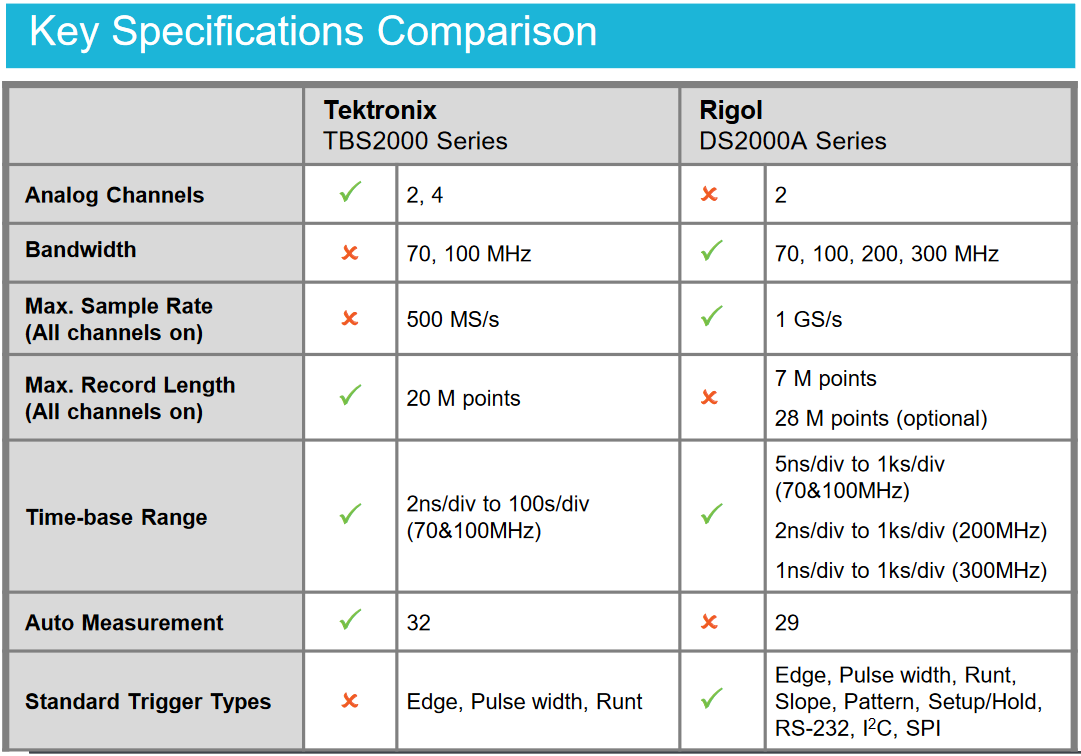
- DS2000A Series: 70–300 MHz, better performance, deeper memory.
- MSO5000 Series: 70–350 MHz, mixed-signal, 8 channels, 8 GSa/s.
- DS7000 Series: High performance, up to 500 MHz, large touchscreen.
Tektronix Oscilloscope Families
Tektronix has a wide range, with a focus on professional and research use:
- TBS1000C Series: 50–200 MHz, simple and reliable, ideal for education.
- TBS2000 Series: 70–200 MHz, big display, easy controls.
- MSO/DPO2000B Series: Mixed-signal, 70–200 MHz, advanced triggers.
- MDO3000, MSO5000, MSO7000 Series: High-end features, up to 1 GHz, deep analysis.
Direct Product Comparison
Here’s a quick side-by-side of two popular models:
| Feature | Rigol DS1054Z | Tektronix TBS1052C |
|---|---|---|
| Bandwidth | 50 MHz (upgradeable) | 50 MHz |
| Channels | 4 | 2 |
| Sample Rate | 1 GSa/s | 1 GSa/s |
| Memory Depth | 24 Mpts | 2.5 kpts |
| Display | 7″ color | 7″ color |
| Price (approx.) | $350–$400 | $500–$600 |
This comparison shows that Rigol often gives more features for the same or lower price, especially in the entry-level market.
Performance And Specifications
When choosing an oscilloscope, specs are important. Here are some key factors to look at:
Bandwidth
Bandwidth tells you the highest signal frequency the oscilloscope can measure correctly. Rigol models often start at 50 MHz and go up to 500 MHz. Tektronix ranges from 50 MHz to well over 1 GHz in their advanced models.
Sample Rate
Sample rate affects how detailed your signal capture is. Both brands offer 1 GSa/s or more on most models, but Tektronix’s high-end scopes can reach up to 25 GSa/s.
Memory Depth
Memory depth is how many data points the scope can hold for each capture. Rigol’s DS1054Z offers 24 Mpts, while Tektronix’s entry-level scopes usually have less (around 2.5 kpts), but their advanced models go much higher.
Display And User Interface
Both brands give you large, color displays (usually 7-inch or bigger). Rigol’s newer models offer touchscreens and fast menus, which help with fast setup. Tektronix is known for clear, logical controls and detailed waveform displays.
Advanced Features
Tektronix leads with advanced triggering, protocol decoding, and analysis tools on their higher-end models. Rigol gives a surprising number of these features, even on low-cost models, but sometimes with limits on performance or depth.
Build Quality And Reliability
One area where Tektronix has a long-standing reputation is build quality. Their instruments are built to last, with solid cases, reliable buttons, and long lifespans. Many labs have Tektronix scopes that are more than 10 years old and still working well.
Rigol, while improving every year, is more focused on value. Their build quality is good for the price, but you might notice lighter materials, less sturdy knobs, and sometimes more fan noise. For home labs or light use, this is rarely a problem.
For 24/7 industrial use, Tektronix’s durability is a key advantage.
Price And Value
Rigol is famous for affordable test equipment. Their entry-level oscilloscopes cost 30–50% less than similar Tektronix models. Even their mid-range scopes stay hundreds of dollars below high-end Tektronix options.
Tektronix, on the other hand, is usually more expensive. The extra cost covers better support, longer warranty, and higher confidence for professional work.
Here’s a look at typical price ranges:
| Model | Rigol Price Range | Tektronix Price Range |
|---|---|---|
| Entry-Level (50–100 MHz) | $300–$600 | $500–$1,200 |
| Mid-Range (200–350 MHz) | $800–$1,500 | $1,500–$4,000 |
| High-End (500 MHz+) | $2,000–$4,000 | $5,000–$20,000+ |
Non-obvious insight: Many Rigol scopes can be “unlocked” via software to increase bandwidth or features. However, this may void your warranty and is not recommended for critical work.
Software And Connectivity
Both companies offer PC connectivity, but their software approaches differ.
Rigol provides free software for remote control, data logging, and firmware updates. Their UltraSigma software is basic but covers most home and lab needs. Advanced users can use SCPI commands for automation.
Tektronix offers more powerful software, such as TekScope and SignalVu, for deep analysis, reporting, and remote access. Some of these tools require paid licenses. Their scopes also work better with lab automation systems and advanced protocols.
Tip: If you plan to use your scope for automated testing or need strong PC analysis, Tektronix may have the edge, especially for large projects.

Credit: www.tequipment.net
Support, Warranty, And Community
Tektronix offers strong customer support, long warranties (often 3–5 years), and worldwide repair centers. They also provide detailed manuals, application notes, and training videos. If you need help, Tektronix is known for quick responses and solid advice.
Rigol has improved support in recent years, especially in North America and Europe. Their warranty is usually 3 years, but service centers may not be as close as Tektronix’s. Forums and online groups like the EEVblog community are good places to get help with Rigol products.
Non-obvious insight: For students and hobbyists, the active online community around Rigol is often more helpful than official support. For companies, Tektronix’s professional support is a big plus.
Use Cases And Who Should Choose Each Brand
Depending on your needs, one brand may be a better fit.
Rigol: Best For Learning, Prototyping, And Budget Labs
- Perfect for students, schools, and hobbyists.
- Offers advanced features for the price.
- Good for small businesses and startups who need modern scopes without breaking the bank.
Tektronix: Best For Industry, Research, And Mission-critical Work
- Trusted in factories, research labs, and aerospace.
- Required when reliability, support, and certification are critical.
- Their scopes are often approved for safety and compliance testing.
Examples Of Real-world Use
- University labs often use both brands: Rigol for teaching and Tektronix for advanced research projects.
- Repair shops and electronics startups may rely on Rigol for everyday debugging.
- Aerospace companies trust Tektronix for projects where mistakes could be costly or dangerous.
Key Factors To Consider Before Buying
Before you make a decision, think about these factors:
- Budget: How much can you spend? Don’t forget to include probes, software, and accessories.
- Features Needed: Do you need advanced triggers, protocol decoding, or lots of memory depth?
- Reliability: Will you use the scope every day, or only a few hours a week?
- Support: How important is fast, local support if something breaks?
- Future Needs: Could your work require higher bandwidth or more channels in the future?
- Ease of Use: Who will use the scope? Students may prefer simple menus. Advanced users may want more control.
- Software: Do you need strong PC analysis tools or automation?
Common mistake: Many buyers focus only on bandwidth and ignore memory depth or sample rate. A low-memory scope can miss fast glitches, even with high bandwidth.
Strengths And Weaknesses: Rigol Vs Tektronix
Here’s a summary of the main strengths and weaknesses for each brand:
Rigol
Strengths
- Low price for high feature count
- Modern interfaces, touchscreens on new models
- Good for learning, experimentation
- Large memory depth on many models
Weaknesses
- Build quality not as strong as Tektronix
- Support and repair less global
- Not always certified for industrial or safety-critical work
- Software less advanced than Tektronix
Tektronix
Strengths
- Excellent build quality and reliability
- Superior support and long warranty
- Advanced analysis tools and connectivity
- Trusted for compliance and critical work
Weaknesses
- Higher cost
- Fewer features per dollar on entry-level models
- Some software tools require extra payment

Credit: www.youtube.com
Data And Trends In The Oscilloscope Market
The oscilloscope market has changed a lot in the last 10 years. Rigol helped make modern digital scopes affordable for everyone. This pushed other brands, including Tektronix, to offer better entry-level products.
According to industry research, Rigol’s global oscilloscope market share has grown from 2% in 2009 to over 10% by 2023. Tektronix still holds a strong presence in the high-end and industrial sector but has responded by adding more affordable lines like the TBS1000C.
Interesting fact: Many new engineers start with Rigol, but as they move to jobs in industry, they often use Tektronix equipment for more complex tasks.
Real User Experiences
What do real users say? Here are some typical experiences from forums, reviews, and lab managers:
- Rigol DS1054Z: “For under $400, I got four channels and deep memory. I use it for Arduino and Raspberry Pi projects. The menu is a bit slow, but it does everything I need.”
- Tektronix TBS2000: “Easy to use, clear display, and our students can’t break it! It’s been running for years with no problems.”
- Rigol MSO5000: “The touchscreen is fantastic. I use it for mixed-signal debugging. Only complaint is the fan noise.”
- Tektronix MSO5000: “The analysis tools save hours on protocol decoding. Worth the price in a professional lab.”
Pro tip: If you can, try both brands before buying. Many electronics stores and universities have demo units you can test.
Looking To The Future
Both brands are pushing for better features. Rigol is adding more advanced models, with touchscreens and better software. Tektronix continues to improve their entry-level products while leading at the high end.
Industry experts expect AI-driven analysis and cloud connectivity to be the next big trends. Both Rigol and Tektronix are investing in these areas, so the gap between them may shrink in the future.
For now, Rigol leads in value and accessibility, while Tektronix is the gold standard for quality and support.
Frequently Asked Questions
What Is The Main Difference Between Rigol And Tektronix Oscilloscopes?
The biggest difference is their target audience and price-to-features ratio. Rigol focuses on affordable, feature-rich scopes for students and hobbyists. Tektronix aims at professionals who need high reliability, better support, and advanced features, often at a higher price.
Are Rigol Oscilloscopes Reliable For Professional Work?
Rigol scopes are reliable for many tasks, especially in education and light industry. For mission-critical work, safety testing, or long-term continuous use, Tektronix is usually preferred because of its build quality and support.
Can I Use Rigol Software With Tektronix Scopes Or Vice Versa?
No, each company’s software is designed for its own products. However, both brands support SCPI commands, so you can write scripts to control them from a PC if needed.
Why Do Some Rigol Scopes Seem To Have More Features For Less Money?
Rigol’s business model is to offer more features per dollar, often by using shared hardware and software upgrades. This sometimes means lower profit margins and less focus on industrial certifications compared to Tektronix.
Where Can I Find More Detailed Reviews And Technical Comparisons?
A good source for in-depth reviews and technical details is the EEVblog Forum, where engineers and hobbyists share real-world experiences with both brands.
Both Rigol and Tektronix have their place in modern electronics labs. By understanding their strengths, weaknesses, and the needs of your work or study, you can choose the right oscilloscope with confidence. Whether you value affordability and features or reliability and support, one of these brands will fit your bench perfectly.
Credit: www.tek.com