When you want to test, measure, or troubleshoot electronic circuits, having the right oscilloscope is crucial. Two popular types are the Digital Storage Oscilloscope (DSO) and the Digital Sampling Oscilloscope (DDS). Both help you view electrical signals, but their designs and ideal uses are different. Many beginners confuse these terms, or wonder which is best for their needs. This guide will clear up the confusion, compare DSO vs DDS oscilloscopes, and help you make a confident choice.
What Is A Dso Oscilloscope?
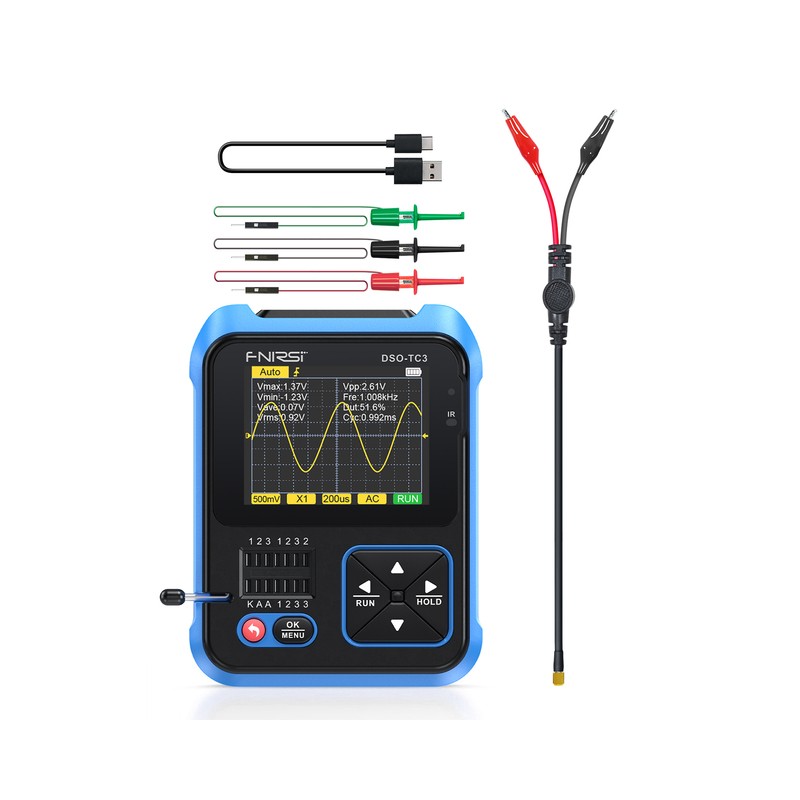
A Digital Storage Oscilloscope is a tool that captures, processes, and stores electrical signals in digital form. It’s the most common modern oscilloscope found in electronics labs, schools, and industry. DSOs replaced older analog scopes thanks to their ease of use, memory features, and advanced analysis.
DSOs convert incoming analog signals into digital data using an Analog-to-Digital Converter (ADC). The data is stored in memory, letting you analyze, replay, or measure signals even after they disappear. This is especially useful for troubleshooting circuits that have intermittent faults or rare glitches.
One key advantage is that DSOs can “freeze” a signal, allowing you to study details long after the event. If you’re working with circuits that behave unpredictably, this feature saves time and reduces guesswork. DSOs also enable storing multiple waveforms for comparison, which is useful when testing different conditions or components.
Key Features Of Dsos
- Memory Storage: Can save waveforms for later viewing. This lets you share results or revisit tests, which is useful for teamwork or documentation.
- Display: Shows clear, sharp signals on digital screens. Many DSOs offer color screens and zoom, helping you spot small changes in signals.
- Analysis Tools: Offers automatic measurements, math functions, and advanced triggering. You can measure voltage, frequency, rise time, and even perform FFT (frequency analysis).
- Ease of Use: User-friendly menus, buttons, and settings. Many DSOs come with USB ports, LAN connections, and touchscreens for easier operation.
A DSO’s versatility means you can use it for different tasks without needing extra equipment. Some models offer built-in help menus or tutorials, which are good for students or new users.
Common Uses
DSOs are ideal for:
- Testing microcontrollers and digital circuits
- Analyzing audio signals
- Checking power supplies
- Diagnosing faults in industrial controls
DSOs are also used in education, letting students safely experiment and understand signal behavior. In production lines, DSOs help monitor quality and spot faulty products before they ship.
Example
Imagine you’re debugging a microcontroller that sometimes fails. A DSO lets you capture and study the exact moment the fault happens, thanks to its memory and triggering features. For example, you can set a trigger condition to catch when voltage drops below a certain level, then review the waveform to find out why the failure occurred.
What Is A Dds Oscilloscope?
A Digital Sampling Oscilloscope is designed for very high-frequency signals, often used in communication and RF (radio frequency) industries. Unlike a DSO, the DDS samples signals at slower rates but uses clever techniques to reconstruct fast waveforms.
DDS oscilloscopes rely on sampling theory. They take samples at intervals, sometimes even slower than the signal’s frequency, but only for repetitive signals. This allows them to capture and analyze signals up to tens or hundreds of gigahertz, which is impossible for most DSOs.
DDS scopes often use specialized probes and connectors to reduce signal loss at high frequencies. The setup requires careful calibration and knowledge of signal properties, making them less suited for general electronics or beginners.
Key Features Of Dds Oscilloscopes
- Ultra-High Bandwidth: Can measure signals above 10 GHz. This is essential for telecom, radar, and advanced research.
- Sampling Techniques: Uses sequential sampling for repetitive signals. By sampling one point per cycle, the DDS builds a detailed picture over time.
- Precision Timing: Offers highly accurate time measurements. This is critical for analyzing signal delays, jitter, or synchronization in fast systems.
Some DDS scopes include software tools for signal reconstruction and comparison, making them good for research and development.
Common Uses
DDS scopes are used for:
- Testing fiber optics and telecom equipment
- Measuring high-speed digital data lines
- Analyzing radar and satellite signals
DDS oscilloscopes are also valuable in physics labs and aerospace, where capturing tiny details of fast, repetitive signals is essential.
Example
If you need to measure a 40 GHz clock signal in a telecom device, a DDS oscilloscope is the tool for the job. It reconstructs the waveform by sampling many cycles of the repetitive signal. For instance, when verifying the integrity of a fiber-optic link, DDS scopes can reveal problems that affect data transmission at extreme speeds.

Credit: www.youtube.com
Dso Vs Dds Oscilloscope: Core Differences
Understanding the differences can help you choose the right oscilloscope for your needs. Here’s a side-by-side comparison:
| Feature | DSO Oscilloscope | DDS Oscilloscope |
|---|---|---|
| Sampling Method | Real-time sampling | Sequential (random) sampling |
| Bandwidth | Up to ~1 GHz (typical) | 10 GHz and above |
| Signal Type | Single-shot & repetitive | Repetitive only |
| Memory | Stores waveforms | Limited storage |
| Ease of Use | User-friendly | Specialized setup |
Sampling Methods Explained
DSOs use real-time sampling. They capture all points of a signal as it happens. This is perfect for signals that change or only appear once.
DDS scopes use sequential sampling. They take one sample per signal cycle, then build the waveform over many cycles. This works only for stable, repetitive signals, but lets DDS reach much higher bandwidth.
If you’re working with random glitches or rare events, real-time sampling is essential. DDS scopes simply cannot handle these cases, as their sampling relies on repeated patterns. This is a detail many new users miss—the method isn’t just about speed, but about signal type.
Memory And Display
DSOs have deep memory, letting you zoom in, store, and analyze signals. DDS scopes focus on speed and timing accuracy, so memory is less important.
DSOs often have detailed displays with grids, markers, and color coding. This helps identify noise, spikes, or timing errors. DDS displays may be simpler, but their main strength is showing ultra-fast transitions.
Which Oscilloscope Should You Choose?
Your choice depends on the signals you want to measure and your typical tasks. Here’s a quick guide:
| Application | Recommended Oscilloscope |
|---|---|
| Microcontrollers | DSO |
| Power electronics | DSO |
| Audio analysis | DSO |
| RF circuit design | DDS |
| Telecom signals (10+ GHz) | DDS |
| High-speed data buses | DDS |
Practical Tips For Choosing
- Check Signal Frequency: If your signals are under 1 GHz, a DSO is usually enough.
- Consider Signal Type: For non-repetitive signals, DSOs are better. For repetitive, high-frequency signals, DDS is ideal.
- Budget: DSOs are cheaper and easier to find for general use. DDS scopes are expensive and specialized.
- Expandability: Some DSOs let you add software or hardware modules for more functions. DDS scopes may require extra accessories for specific measurements.
Two Non-obvious Insights
- Many beginners try to use DSOs for RF signals above 1 GHz. While specs may claim high bandwidth, real-time sampling often limits accuracy. Always check the effective bandwidth and sample rate.
- DDS scopes cannot capture one-time events. If you’re troubleshooting glitches or rare faults, DDS will miss them completely.
A third tip: signal integrity is critical at high frequencies. Even a small cable or connector can distort signals above 10 GHz. Always use quality probes and check calibration.
Technical Specifications: What Matters Most
When comparing DSOs and DDS oscilloscopes, focus on these specs:
- Bandwidth: The highest frequency the oscilloscope can measure accurately.
- Sample Rate: DSOs need high real-time sample rates; DDS uses lower rates due to sequential sampling.
- Memory Depth: Important for DSOs; lets you capture long signals or zoom in.
- Triggering Options: Good triggering helps you capture rare events (DSO) or synchronize repetitive signals (DDS).
- Input Impedance: Ensures signal integrity, especially at high frequencies.
Beyond specs, consider update rate (how often the screen refreshes) and vertical resolution (how many bits the ADC uses). Higher resolution means more accurate measurements, especially for low-level signals.
Example Specifications
Let’s compare two models:
| Model | Type | Bandwidth | Sample Rate | Memory Depth |
|---|---|---|---|---|
| Tektronix TBS2000 | DSO | 200 MHz | 1 GS/s | 20 Mpts |
| Agilent 86100D | DDS | 50 GHz | 250 kS/s | 2 Mpts |
Notice how the DDS model has much higher bandwidth, but much lower sample rate. This is because DDS scopes rely on repetitive signal sampling.
Pros And Cons Of Each Oscilloscope
Understanding strengths and weaknesses helps you avoid mistakes.
Dso Oscilloscope
Pros:
- Easy to use for most tasks
- Good memory and analysis features
- Captures single-shot events
- Versatile for education, design, and repair
Cons:
- Limited bandwidth (usually <1 GHz)
- May miss fast signals if sample rate is low
- Not ideal for very high-speed RF
Dds Oscilloscope
Pros:
- Ultra-high bandwidth
- Excellent timing precision for repetitive signals
- Essential for telecom and RF research
Cons:
- Cannot capture one-time events
- Setup is more complex
- Expensive
- Not suitable for general electronics or beginners
Credit: kamami.pl
Common Mistakes When Selecting An Oscilloscope
- Ignoring Signal Type: Choosing DDS for single-shot signals is a waste.
- Overestimating Bandwidth Needs: Buying a DDS when a DSO is enough increases costs.
- Not Checking Sample Rate: For DSOs, sample rate should be at least 5x the signal frequency for accurate results.
- Missing Trigger Features: Weak triggers can make capturing faults difficult.
- Assuming All Digital Oscilloscopes Are the Same: DSOs and DDS have very different designs.
- Neglecting Probe Quality: Using poor probes with high-frequency signals can lead to wrong measurements, especially with DDS.
Real-world Examples
- In automotive repair, technicians use DSOs to catch glitches in sensor signals. For example, finding a faulty camshaft sensor that causes random engine stalls.
- Telecom engineers use DDS scopes to analyze high-speed optical networks. They can measure signal integrity at 40 GHz, ensuring data transmission is reliable.
- Audio labs rely on DSOs for waveform analysis and distortion checks. DSOs allow engineers to compare original and processed signals, optimizing audio quality.
In research, DDS scopes are used to verify synchronization in satellite communication, where timing errors can lead to lost data.
Credit: www.aliexpress.com
How Technology Has Changed Oscilloscopes
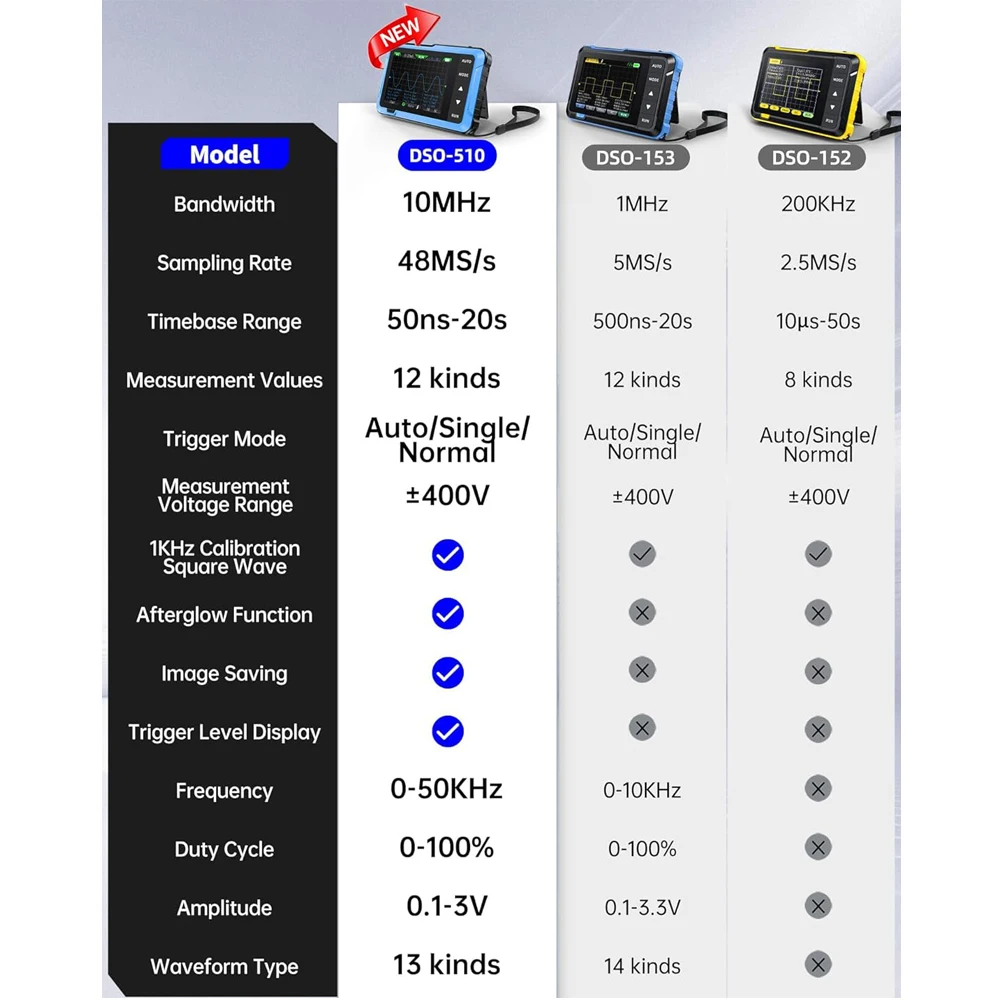
Modern DSOs have improved memory, display quality, and software. Entry-level models offer features that were once only found in expensive scopes. DDS scopes are mostly used in research and telecom, but advances are bringing prices down slowly.
Manufacturers like Tektronix, Keysight, and Rigol lead the market. For deep technical info, see Wikipedia.
Cloud connectivity and remote access are now common in DSOs, letting you monitor tests from anywhere. Firmware updates add new features over time. DDS technology is advancing, with better sampling rates and easier interfaces, though the price gap remains.
Frequently Asked Questions
What Is The Main Difference Between Dso And Dds Oscilloscopes?
The main difference is how they sample signals. DSOs use real-time sampling for both single-shot and repetitive signals, while DDS oscilloscopes use sequential sampling, which is only suitable for repetitive signals.
Can A Dso Measure High-frequency Signals?
DSOs can measure high-frequency signals up to their rated bandwidth, usually under 1 GHz. For signals above 1 GHz, accuracy drops unless the sample rate and bandwidth are very high. Also, signal quality may be affected by probe and cable limitations.
Why Can’t Dds Oscilloscopes Capture Single-shot Events?
DDS oscilloscopes build waveforms from many cycles of a repetitive signal. They cannot capture one-time events because their sampling method needs repeated signals.
Are Dsos Easier To Use Than Dds Oscilloscopes?
Yes, DSOs are easier to use for most people. They have user-friendly interfaces, automatic measurements, and memory features. DDS scopes require specialized setup and knowledge.
How Do I Decide Which Oscilloscope To Buy?
First, consider the frequency and type of signals you want to measure. If your work involves high-frequency, repetitive signals (like telecom or RF), go for DDS. For general electronics, troubleshooting, or single-shot events, a DSO is best.
Also, check your workspace and experience level. DSOs are best for learning and day-to-day tasks. DDS is for advanced research or high-speed design.
Final Thoughts
Choosing between a DSO and a DDS oscilloscope depends on your needs, budget, and the signals you work with. DSOs cover most electronics tasks, offering memory, analysis, and simple use. DDS scopes are powerful for high-frequency, repetitive signals but are specialized and expensive.
Understanding their differences, strengths, and weaknesses prevents costly mistakes and ensures you get the right tool for your projects. With this knowledge, you can select the oscilloscope that fits your work—whether in a school lab, industry, or advanced research.