An ohm meter and a multimeter are two of the most common tools used in electronics, electrical work, and DIY troubleshooting. At first glance, they look similar—both have probes, displays, and dials. But their purposes, functions, and value to users are very different.
If you’re new to working with electrical circuits or want to avoid costly mistakes, understanding the differences between these tools is essential. This article explores the ohm meter vs multimeter debate in depth. You’ll learn not just what they do, but when to use each, how to read them, and why owning one over the other can make your work easier or harder.
What Is An Ohm Meter?
An ohm meter is a device designed to measure only one thing: electrical resistance. Resistance is measured in ohms (Ω), and it tells you how much a material or component resists the flow of electric current. When you measure resistance, you’re often checking if a wire, resistor, or circuit path is broken or in good condition.
Ohm meters work by sending a tiny current through the component and measuring how much the current is slowed down. If the resistance is very high, it means the component might be open or damaged. If it’s very low, it can mean there’s a short circuit or the component is fine, depending on the context.
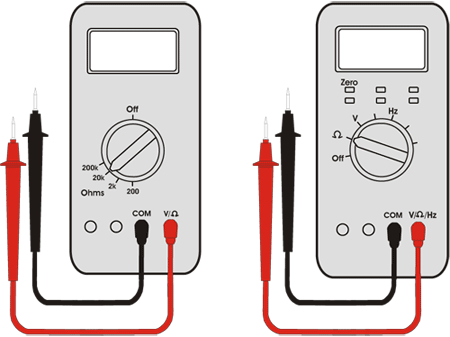
Most standalone ohm meters are very simple. They have a needle or a digital display, two probes, and a knob to select the measuring range. You’ll usually find them in basic electronics kits or used by people who only need resistance measurements.
What Is A Multimeter?
A multimeter is a versatile tool that combines several measurement functions in one device. The most basic multimeters can measure:
- Voltage (volts, V)
- Current (amperes, A)
- Resistance (ohms, Ω)
Modern digital multimeters (DMMs) can do much more. Some models can test diodes, transistors, capacitance, temperature, and even frequency. This flexibility is why multimeters are found in almost every electrician’s, technician’s, and hobbyist’s toolbox.
Multimeters have a dial or buttons to select the type of measurement, a display (analog or digital), and two or more probes. Their resistance measuring function is the same as an ohm meter, but with added features.
Key Differences: Ohm Meter Vs Multimeter
While both devices can measure resistance, their design and features set them apart. Here are the main differences:
| Feature | Ohm Meter | Multimeter |
|---|---|---|
| Primary Function | Measures resistance only | Measures resistance, voltage, current, and often more |
| Ease of Use | Very simple, few settings | More settings, learning curve for some |
| Display Type | Usually analog or basic digital | Digital or advanced analog |
| Cost | Usually cheaper | Wider price range, basic to advanced |
| Size & Portability | Often small and light | Can be larger, but pocket-sized models exist |
| Advanced Features | Rare | Common in many models (diode, continuity, etc.) |
A beginner may think, “Why not always use a multimeter? ” The answer depends on your needs, budget, and how often you measure only resistance.
How Ohm Meters Work
Understanding how an ohm meter operates helps prevent mistakes. Inside, the device has a small battery. When you connect the probes across a resistor or wire, the meter sends a small current through the circuit. The meter then measures the voltage drop and calculates resistance using Ohm’s Law (R = V/I).
Ohm meters are designed to work only on unpowered circuits. Connecting an ohm meter to a live circuit can damage the meter and give false readings. This is a common mistake for beginners.
Ohm meters can be:
- Analog: A needle moves on a scale to show resistance.
- Digital: The value appears as numbers on a screen.
Some analog ohm meters require “zero adjustment. ” You touch the probes together and turn a knob so the needle points to zero. This ensures accurate measurements, especially as the battery gets weaker.

Credit: www.wikihow.com
How Multimeters Work
A multimeter contains several measurement circuits in one device. When you select “ohms” on the dial, it behaves much like a standalone ohm meter: using an internal battery to send a current and measure resistance.
For voltage, the multimeter measures the potential difference between two points. For current, it measures how much charge flows through the meter. Advanced models have microprocessors and offer features like auto-ranging (automatic selection of the right scale), data hold, backlit screens, and even Bluetooth connectivity.
Multimeters can measure both AC (alternating current) and DC (direct current) depending on the model. This adds to their usefulness in more complex troubleshooting.
When Should You Use An Ohm Meter?
An ohm meter is best when you need to measure only resistance, and you want a simple, reliable tool. Common scenarios include:
- Checking if a wire is broken inside (infinite resistance means open circuit).
- Testing resistors for their value.
- Verifying continuity (though most multimeters have a continuity test mode now).
- Educational labs where basic measurements are taught.
One non-obvious advantage: a dedicated ohm meter’s circuit is usually less complex, so it can sometimes give faster or more stable readings, especially on old analog types. For beginners, fewer settings mean less chance of mismeasurement.
When Should You Use A Multimeter?
A multimeter shines when you need more than just resistance readings. Use it for:
- Checking voltage at outlets, batteries, or power supplies.
- Measuring current in a circuit (e.g., to check battery drain).
- Measuring resistance across components or checking continuity.
- Testing diodes, transistors, or capacitors (on advanced models).
Multimeters are valuable for troubleshooting electronics, home wiring, car electrical systems, and battery-powered devices. Their flexibility makes them a better investment for most users, unless you only ever need to measure resistance.
Practical Examples
Example 1: Faulty Lamp
You have a desk lamp that won’t turn on. You suspect the power cord is broken.
- With an ohm meter: Unplug the lamp, touch the probes to each end of the power cord. A high resistance means the wire is broken.
- With a multimeter: Set to resistance or continuity, do the same test. If you want to check if power is coming to the lamp, switch to voltage mode and test at the plug (when plugged in).
Example 2: Testing A Battery
You want to know if a 9V battery is still good.
- An ohm meter can’t help. It’s not designed for voltage.
- A multimeter: Set to DC voltage, touch probes to battery terminals. If you see a reading close to 9V, the battery is good.
Example 3: Checking A Resistor
You found a resistor in a parts bin, color bands are hard to read.
- Both ohm meter and multimeter can measure its resistance.
- Multimeter may give a digital reading, making it easier to read and log.
Measuring Accuracy
Accuracy matters when dealing with sensitive electronics. Multimeters usually have better accuracy than basic ohm meters, especially digital models. Modern DMMs can measure resistance down to fractions of an ohm or up to megaohms, and often have auto-calibration.
However, one non-obvious insight: analog ohm meters can sometimes detect brief contact issues or intermittent faults because the needle moves in real time. Digital meters update slower and may miss these quick glitches.
Safety Considerations
Beginners often forget that ohm meters and multimeters must never measure resistance on a live circuit. Measuring resistance on a powered circuit can damage the device, harm you, or destroy components. Always disconnect power before using resistance mode.
For voltage and current, multimeters are designed to handle live measurements. But you must always set the correct measurement type and range. Choosing the wrong setting (for example, measuring current when you should measure voltage) can blow a fuse inside the meter or worse.
Insider tip: Always start on the highest range, then move down for a more accurate reading. This protects both you and the meter.
Features To Consider When Choosing
If you’re deciding between buying an ohm meter or a multimeter, here are key factors:
1. Measurement Needs
- If you only check resistors or wires, an ohm meter is enough.
- For general troubleshooting, a multimeter is better.
2. Budget
- Ohm meters are cheaper. But even basic digital multimeters are affordable today, often under $20.
3. Durability
- Multimeters may have tougher cases, rubber bumpers, and better probes.
- Ohm meters are simpler, but not always as rugged.
4. Advanced Features
- Multimeters can have data logging, auto-ranging, and special test modes.
- Ohm meters rarely offer these extras.
5. Ease Of Use
- Beginners may prefer the simplicity of an ohm meter.
- Multimeters require learning to set the correct mode and range.
Common Beginner Mistakes
Mistakes with these meters can cause confusion, wrong readings, or even damage. Here are common errors:
- Measuring resistance on a live circuit: Always turn off and discharge capacitors before measuring ohms.
- Wrong probe placement: For current measurements, probes must be in series with the circuit; for voltage, in parallel.
- Wrong setting: Setting a multimeter to amps when you want to measure voltage can cause problems.
- Ignoring meter limits: For high voltages or currents, use a meter rated for the job.
- Not zeroing analog meters: Always adjust before measuring for accuracy.

Credit: www.youtube.com
Advantages And Disadvantages
A side-by-side comparison helps make the choice clearer.
| Aspect | Ohm Meter | Multimeter |
|---|---|---|
| Specialization | Simple, focused on resistance | Versatile, many functions |
| Learning Curve | Very easy | Requires practice |
| Price | Lowest cost | Range from low to high |
| Accuracy | Good for resistance | High for all functions (especially digital) |
| Features | Basic | Advanced (auto-range, data hold, etc.) |
| Replacement Parts | Rarely needed | Probes and fuses can be replaced |
Which One Should You Buy?
For most people today, a digital multimeter is the better choice. It covers resistance (ohms), voltage, and current—and even more with advanced models. The cost difference is small, but the extra value is huge.
However, if you are a teacher, work in a lab, or want a tool for one purpose only, a simple ohm meter can be less confusing for students and beginners. It’s also a good backup when your main multimeter is in use or out of batteries.
One often-overlooked point: high-end analog ohm meters are still used in certain industrial or laboratory settings because they’re less affected by electrical “noise” or interference. But for most home or field use, a digital multimeter is easier to read and more flexible.
How To Use An Ohm Meter Safely
Here’s a quick guide for safe and accurate use:
- Make sure the circuit is powered off.
- Select the correct range (if not auto-ranging).
- Touch the probes together to check zero reading (analog only).
- Connect the probes to the two ends of the component or wire.
- Read the value and compare to expected resistance.
Always avoid touching the metal part of the probes when measuring. Sweat and oils on your fingers can affect accuracy, especially for low resistance values.
How To Use A Multimeter Safely
For resistance:
- Power off the circuit.
- Set dial to Ω (ohms) or continuity.
- Connect probes across the component.
For voltage:
- Power on the circuit.
- Set dial to V (voltage), AC or DC.
- Connect probes across the two points you want to measure.
For current:
- Power on the circuit.
- Set dial to A (amps), AC or DC.
- Break the circuit and connect the meter in series so all current flows through it.
Always start with the highest range to prevent overload, and work down for more precise readings.
Credit: gotech.com
Real-world Applications
Both meters are used in a wide range of jobs:
- Electricians check household wiring, outlets, switches.
- Electronics hobbyists build and repair gadgets, measure components.
- Automotive technicians diagnose car electrical problems.
- HVAC specialists test sensors, motors, relays.
- Teachers use them in labs to teach basic circuit concepts.
A key insight: Many professionals own several meters—one high-end multimeter for accuracy, and a simple analog ohm meter for quick checks.
Digital Vs Analog Models
Most people use digital meters today because they are easier to read, more accurate, and offer more features. Analog meters can still be useful for:
- Detecting quick or intermittent faults (needle movement shows changes).
- Measuring slow-changing signals.
- Working in environments with electrical noise.
But analog meters are harder to read, need zero adjustment, and are more fragile. For most users, digital is best.
Calibration And Maintenance
A meter is only useful if it’s accurate. Over time, batteries can weaken, and internal components can drift. Calibration means adjusting the meter so it reads accurately.
- For ohm meters, zeroing is essential before each use (analog).
- For multimeters, professional models can be calibrated by a technician.
- Replace batteries regularly—weak batteries cause errors.
- Store meters in a dry place, protect from drops and impacts.
Most modern digital meters have self-check features, but if readings seem “off,” check with a known resistor or voltage source.
Environmental And Safety Standards
Look for meters that meet international safety standards. For example, CAT II, CAT III, or CAT IV ratings show what kind of circuits the meter can safely handle. A higher CAT rating means better protection against high voltage spikes.
Also, check if the meter has a CE or UL mark. These show the meter meets certain safety standards for electronics.
How To Read The Display
- Analog meters: Watch the needle. Read the value where it points on the scale. Make sure you’re reading the right scale for your range.
- Digital meters: Simply read the number. Some have a “hold” button to freeze the value.
For both, always note the units (Ω, kΩ, MΩ for resistance; V for voltage; A for current).
What Beginners Often Miss
- Auto-ranging: Most new users don’t realize how helpful this feature is. Auto-ranging meters pick the best range automatically, preventing overloads and making readings faster.
- Continuity buzzer: Many multimeters beep when there is a closed circuit. This is great for quick checks without looking at the display.
- Fuse protection: Multimeters often have internal fuses to protect against mistakes. If your meter stops reading current, the fuse may need replacement.
Trusted Brands And Where To Buy
When buying, consider brands like Fluke, Klein Tools, Extech, or Mastech. These are known for accuracy, safety, and durability. For beginners, models from hardware stores or online retailers are often enough, but beware of very cheap, unbranded meters—they may be inaccurate or unsafe.
For more on safety standards and ratings, you can visit the Wikipedia page on multimeters.
Frequently Asked Questions
What Is The Main Difference Between An Ohm Meter And A Multimeter?
An ohm meter measures only resistance, while a multimeter can measure resistance, voltage, and current. Multimeters often have more features, making them more versatile for most electrical work.
Can A Multimeter Replace An Ohm Meter?
Yes. A multimeter can do everything an ohm meter does, plus more. Most people use multimeters today because they cover more needs.
Is It Safe To Measure Resistance On A Powered Circuit?
No. You should always turn off and disconnect power before measuring resistance with any meter to avoid damage and inaccurate readings.
Which Tool Is Better For Beginners?
For total beginners, an ohm meter is simpler and harder to misuse. But most people learn quickly to use a digital multimeter, which is more useful in the long run.
Why Does My Digital Multimeter Show “ol” When Measuring Resistance?
“OL” means over limit or open loop. This usually happens if the component or wire is broken or not connected, so resistance is too high for the meter to measure.
Choosing between an ohm meter and a multimeter may seem confusing at first, but once you understand their roles, your electrical work becomes safer, faster, and more accurate. The right tool not only protects your circuits but also builds your confidence as you learn and work.