When you’re troubleshooting electrical problems in cars or electronics, you often hear about two tools: the Power Probe and the multimeter. Both are essential, but they do very different jobs. Choosing the right tool can make your work faster, safer, and more accurate. Many beginners struggle to decide which tool is better or if they need both. This article will help you understand their differences, strengths, and weaknesses. You’ll also learn how to use them, common mistakes, and real-world examples where each shines. If you want to work smarter—not harder—keep reading.
What Is A Power Probe?
A Power Probe is a tool designed mainly for automotive electrical testing. It looks like a handheld pen with a screen, buttons, and two wires: one for power, one for ground. Unlike a simple test light, the Power Probe can not only check for voltage but can also supply power or ground to a circuit. This makes it much more than a basic tester.
Most Power Probes have features like:
- Digital display for voltage readings
- Ability to send power or ground to a component
- Audible alerts for continuity or voltage presence
- Built-in flashlight for dark engine bays
For example, if you want to test if a window motor works, you can use the Power Probe to send power directly to the motor, bypassing switches and relays. If the window moves, the motor is good and the problem is elsewhere.
Key Types Of Power Probes
There are several versions, but the most popular is the Power Probe III. Newer models add more advanced features, like:
- Resistance testing
- Short circuit detection
- Circuit breaker protection
Some models even include an oscilloscope, but for most users, the basic functions are enough.
What Is A Multimeter?
A multimeter is a universal tool for measuring electrical values. The most common measurements are:
- Voltage
- Current (amperes)
- Resistance (ohms)
- Continuity
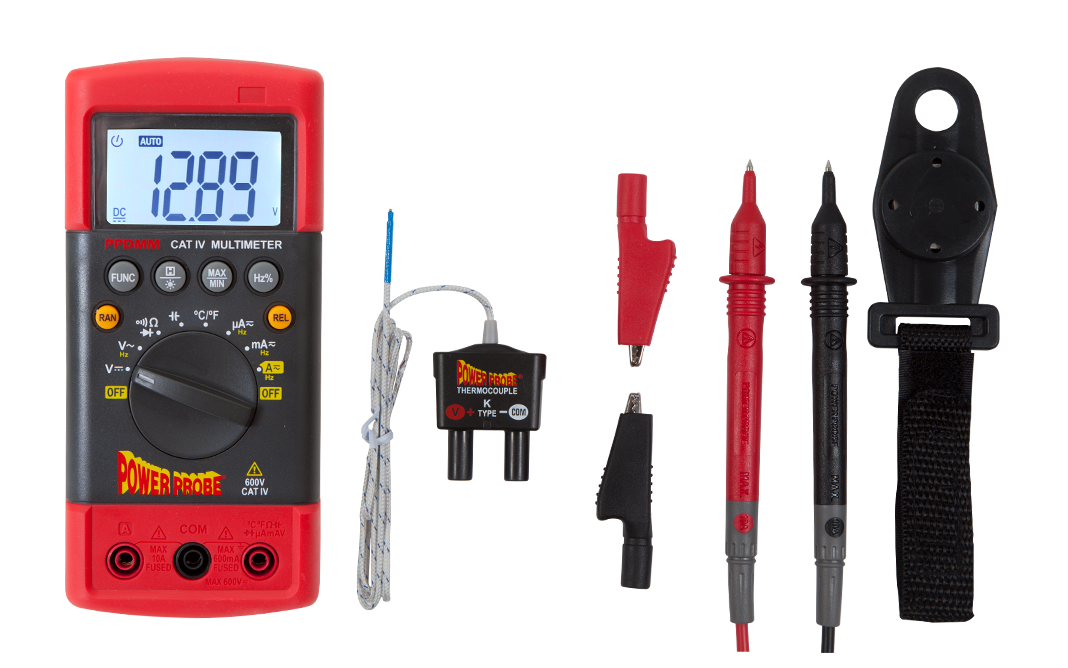
There are analog multimeters (with a moving needle) and digital multimeters (with a digital screen). Digital models are more popular today because they’re easier to read and usually more accurate.
Multimeters are used in many fields—automotive, electronics, home wiring, HVAC, and more. Their main strength is versatility: one tool can measure many things.
Main Multimeter Types
- Basic Digital Multimeter: Measures voltage, current, resistance, and sometimes continuity.
- Auto-ranging Multimeter: Automatically selects the correct measuring range.
- Clamp Meter: Measures current by clamping around a wire without breaking the circuit.
- Bench Multimeter: High-precision, usually used in labs.

Credit: www.ebay.com
Core Differences: Power Probe Vs Multimeter
It’s easy to think these tools are similar, but their key differences are important.
| Feature | Power Probe | Multimeter |
|---|---|---|
| Main Use | Automotive circuit testing, quick checks, powering components | Measuring voltage, current, resistance in any electrical circuit |
| Can supply power/ground? | Yes | No |
| Measures current directly? | No | Yes |
| Continuity Test | Yes (audible/visual) | Yes (audible/visual) |
| Display Type | Digital only | Analog or digital |
| Common Fields | Mainly automotive | Automotive, electronics, home wiring, HVAC, labs |
The Power Probe is specialized for car circuits, while the multimeter is a general tool for almost any electrical work.
How Each Tool Works In Real Situations
To understand which is better for your needs, see how each tool works step by step.
Using A Power Probe
- Connect the tool to the car battery (or power source)
- Touch the tip to a wire or connector
- The screen shows if there’s power, ground, or no connection
- Press a button to send power or ground to test a component
Example: If a car horn doesn’t work, you can use the Power Probe to send power directly to the horn. If it sounds, the horn is fine—the problem is probably the switch or wiring.
Using A Multimeter
- Set the dial for what you want to measure (voltage, current, resistance)
- Connect the leads to the circuit
- Read the value on the screen
Example: If a household light isn’t working, you can use a multimeter to check if voltage is present at the socket, if the bulb is continuous (not broken), or if the switch has failed.
Strengths And Weaknesses
Understanding the unique strengths and limitations will help you choose the right tool for the job.
Power Probe Strengths
- Saves time: You can quickly power or ground components without extra wiring.
- Easy to use: No need to set ranges or modes.
- Great for finding bad wires: You can trace a wire for power or ground problems.
- Safe for 12V systems: Built-in protection prevents damage to car electronics.
- Built for the field: Most models are tough and can handle dirty, oily environments.
Power Probe Weaknesses
- Limited to 12V/24V: Not suitable for high-voltage or home wiring.
- Can’t measure current: You can’t see how many amps a component draws.
- Can damage sensitive parts: If misused, sending power to the wrong place can cause damage.
- Not for complex electronics: No advanced measurement functions.
Multimeter Strengths
- Very versatile: Use in cars, homes, electronics, HVAC, and more.
- High accuracy: Precise measurements for voltage, current, and resistance.
- Safe for many voltages: Works with AC and DC, from small batteries to home power.
- Many features: Some models have temperature, frequency, diode tests, and more.
- No risk of powering circuits: You only measure, you don’t inject power.
Multimeter Weaknesses
- Slower for some tasks: You need to change settings and move leads often.
- Can be confusing: Many buttons and symbols, especially for beginners.
- No way to power components: You can’t activate a relay, motor, or light with the tool.
- Less rugged: Some cheap models break easily if dropped or exposed to water.
Practical Examples: When To Use Each Tool
Many people ask, “Do I need both? ” Often, the answer is yes—especially if you work on cars and do general electronics. Here are real-world examples for each.
Power Probe Scenarios
- Testing a car headlight circuit: Quickly check if power reaches the bulb and send power to the connector to see if the light works.
- Checking window motors: If the window doesn’t move, send power with the probe. If it works, the motor is fine.
- Finding broken wires: Trace a wire from the fuse box to the device, looking for where power is lost.
- Testing switches and relays: Activate relays by sending power, checking if the relay clicks or the load works.
Multimeter Scenarios
- Diagnosing a dead outlet: Check for voltage, measure continuity of wires, and test the circuit breaker.
- Measuring battery voltage: See if your car battery or remote control battery is good.
- Checking for parasitic drain: Measure how much current is drawn from a car battery while the car is off.
- Testing sensors: Measure the resistance or voltage of sensors in cars or appliances.
How To Choose: Power Probe Or Multimeter?
Selecting the right tool depends on your needs, experience, and budget.
| Scenario | Best Tool | Why? |
|---|---|---|
| Quick car wiring check | Power Probe | Faster for checking power/ground, can activate components |
| Home electrical issues | Multimeter | Handles higher voltages, safer for AC power |
| Measuring current draw | Multimeter | Can measure amps directly |
| Testing small electronics | Multimeter | More accurate, handles low voltages and delicate parts |
| Tracing shorts in car wiring | Power Probe | Quickly finds bad wires, built-in safety for cars |
Budget And Training
If you’re just starting and only do basic electrical checks, a simple multimeter is often enough. If you work on cars often, a Power Probe will save you hours. Professionals usually own both.
Common Mistakes And How To Avoid Them
Even experienced users make errors with these tools. Here’s what to watch for.
With Power Probes
- Sending power to the wrong circuit: Can fry computers or sensors. Always check the wiring diagram first.
- Using on high-voltage systems: Power Probe is not made for home AC or hybrid car batteries.
- Not checking grounds properly: A bad ground can give false results.
- Forgetting the built-in circuit breaker: If the probe trips, investigate why—don’t just reset and try again.
With Multimeters
- Wrong dial setting: Measuring voltage in the amp setting can blow the fuse inside the meter.
- Touching live wires with leads set to resistance: Can damage the meter or cause sparks.
- Using old or damaged probes: Leads can break, giving false readings.
- Ignoring auto-ranging/manual setting: Wrong range can make readings confusing or dangerous.
Credit: powerprobe.com
Features To Look For: Buying Guide
If you’re shopping for your first Power Probe or multimeter, here’s what matters most.
For Power Probes
- Circuit protection: Built-in fuse or breaker prevents damage.
- Voltage range: Should handle 12V and 24V (for trucks).
- Length of leads: Longer cables are easier for large vehicles.
- Display clarity: Bright, easy-to-read screen.
- Accessories: Some kits include back-probes, alligator clips, or storage cases.
For Multimeters
- Accuracy: Look for a low count of error (±0.5% or less is good).
- Safety rating: CAT II/III/IV rating for home or industrial use.
- Auto-ranging: Saves time and reduces errors.
- Data hold: Freezes the reading for awkward spots.
- Backlight: Helps in dark places.
- Replaceable fuses: Protects the meter from mistakes.
- Additional tests: Diode, capacitance, frequency, temperature if you need them.
Pro tip: Don’t buy the cheapest tool—quality matters for safety and accuracy. Brands like Fluke, Klein, and Power Probe are trusted by professionals.
Two Insights Beginners Often Miss
- Power Probe is not a replacement for a multimeter: Many new users think the Power Probe can do everything, but it cannot measure current or work safely on AC power. It’s a specialty tool, not an all-in-one solution.
- Multimeter’s accuracy can be a safety issue: Cheap, inaccurate meters can miss dangerous faults or give wrong results. This can lead to electric shocks or expensive mistakes. Always verify readings and understand your meter’s limits.
Real-world Case Studies
Automotive Technician
Mike is a car mechanic. He uses a Power Probe to quickly check window motors, horns, and lights. When a car comes in with a dead battery, he uses the multimeter to check voltage and current draw. He says, “The Power Probe saves me time, but my multimeter is the first thing I grab for batteries and alternators.
”
Homeowner
Sara bought a multimeter to check her home’s outlets and find why some lights flickered. She never uses a Power Probe because she doesn’t work on cars. Her multimeter helped her spot a bad breaker before it caused a fire.
Electronics Hobbyist
Carlos builds small robots. He only uses a multimeter because his circuits are low voltage and sensitive. The Power Probe would damage tiny chips. He values the multimeter’s accuracy for measuring resistance and checking for shorts.
Safety Considerations
Both tools are safe if used correctly, but misuse can be dangerous.
- Never use a Power Probe on house wiring: It’s only for low-voltage DC circuits.
- Check the voltage rating on your multimeter: Don’t use a meter rated for 600V on a 1000V circuit.
- Replace damaged leads or probes immediately.
- Read the manual: Every model is different—learn how your tool works before testing live circuits.
For more on electrical safety, visit the OSHA Electrical Safety page.
Which Tool Should You Get First?
If you’re a car owner who does basic repairs, start with a good digital multimeter. It’s useful for batteries, fuses, sensors, and even home gadgets. If you become more advanced or work professionally in auto repair, add a Power Probe to your toolbox.
For home or electronics use, the multimeter is always the better first choice.
Frequently Asked Questions
What Can A Power Probe Do That A Multimeter Can’t?
A Power Probe can supply power or ground to a circuit, letting you activate components like motors or relays directly. A multimeter only measures values—it can’t power anything.
Is A Power Probe Safe For All Types Of Vehicles?
Power Probes are safe for 12V and 24V vehicles (cars, trucks, motorcycles). Never use them on high-voltage hybrid or electric car batteries, or household AC circuits.
Can A Multimeter Test Car Wiring As Well As A Power Probe?
A multimeter can test car wiring, but it’s slower and can’t activate components. For simple voltage, resistance, or continuity checks, it works well. For quick diagnostics or powering parts, the Power Probe is faster.
How Much Should I Spend On A Multimeter Or Power Probe?
For a reliable multimeter, expect to pay $30–$100 for good quality. Basic Power Probes start around $60, but advanced models can cost $150 or more. Avoid very cheap tools—they can be unsafe or inaccurate.
Can I Damage My Car By Using These Tools Incorrectly?
Yes. Sending power to the wrong circuit with a Power Probe can damage computers or sensors. Using a multimeter on the wrong setting (e. g. , measuring amps instead of volts) can blow fuses or harm the meter. Always double-check your connections and settings.
A Power Probe and a multimeter are both powerful tools, but they serve different needs. Most professionals and serious DIYers end up owning both. If you learn how to use each tool correctly, your electrical work will be faster, safer, and more accurate.

Credit: shop.powerprobe.com