A megohmmeter and a multimeter look similar and often appear in the toolkits of electricians, engineers, and technicians. But these instruments serve different purposes, test different things, and are not interchangeable. Choosing the right tool can save time, prevent damage, and even protect lives.
If you are new to electrical testing or want to understand these devices better, this article will guide you through their differences, uses, and how to decide which one fits your needs.
Let’s discover what sets a megohmmeter apart from a multimeter, how each works, and what to consider before using either.
What Is A Megohmmeter?
A megohmmeter is also called an insulation tester or sometimes a “megger” (after a famous brand). Its main job is to measure very high resistance—usually in the range of megaohms (MΩ). This device checks how well electrical insulation is working in wires, motors, transformers, and other equipment.
A megohmmeter applies a high DC voltage, often between 250V and 1000V (sometimes higher), across the insulation. It then measures how much current flows through that insulation. If the insulation is good, almost no current will flow, and the resistance will be very high. If there is a problem—like moisture, cracks, or breakdown—the resistance drops, and the megohmmeter shows a lower value.
Insulation testing is critical in many industries because poor insulation can cause short circuits, equipment failure, or electric shocks.
Key Features Of Megohmmeters
- High resistance measurement: Typically from 1 MΩ to thousands of MΩ.
- High test voltages: Much higher than a standard multimeter.
- Safety: Designed to prevent user shocks during high-voltage tests.
- Specialized use: Mostly for insulation and leakage testing, not for everyday electrical measurements.
Common Applications
- Testing motor windings before starting machines
- Checking cable insulation in new and old installations
- Evaluating transformers for internal breakdowns
- Routine maintenance in power plants and factories
- Troubleshooting electrical faults that regular meters cannot detect
What Is A Multimeter?
A multimeter is a versatile tool found in almost every toolbox. It can measure voltage, current, and resistance—usually at lower ranges than a megohmmeter. Most modern multimeters are digital (DMMs), but analog types still exist.
With a multimeter, you can quickly check batteries, test wall outlets, verify fuses, or find broken wires. Some advanced models can also measure capacitance, frequency, temperature, and more.
Multimeters are safe for low to medium voltages and currents, and they do not inject high voltages into the circuit during resistance checks.
Key Features Of Multimeters
- Multi-function: Measures voltage (AC/DC), current (AC/DC), resistance (ohms), and sometimes more.
- Low test voltage: Uses a small internal battery for resistance checks.
- Portable: Compact, light, and easy to carry.
- Broad use: From home repairs to professional electronics work.
Common Applications
- Checking batteries and power supplies
- Testing switches and fuses
- Finding faulty connections in circuits
- Measuring electrical parameters in appliances
- Educational projects and DIY repairs

Credit: www.gvda-instrument.com
Core Differences Between Megohmmeter And Multimeter
While both devices measure resistance, the way they do it—and the results they give—can be very different. Here’s a closer look at the main distinctions.
| Feature | Megohmmeter | Multimeter |
|---|---|---|
| Primary Use | Insulation resistance testing | General electrical measurements |
| Resistance Range | MΩ to GΩ (high resistance) | mΩ to MΩ (low to medium resistance) |
| Test Voltage | 250V–1000V+ (high DC) | 3V–9V (low DC, from battery) |
| Safety Features | Built-in for high voltage tests | Limited (low voltage only) |
| Extra Functions | Some models: PI, DAR, leakage | Many: voltage, current, continuity, etc. |
Measurement Limits
- Megohmmeter: Can measure resistances too high for a multimeter (like insulation in the millions of ohms).
- Multimeter: Accurate for low to medium resistance (wires, resistors) but cannot test insulation properly.
Test Voltage Differences
A critical difference is the voltage used for resistance testing. A multimeter uses a small internal battery (usually 1. 5V or 9V). This is safe for electronics but too low to test insulation. A megohmmeter uses high voltage to stress the insulation and find weak spots.
Non-obvious insight: Using a multimeter to check insulation can give a “false pass.” It might show high resistance at low voltage, but the insulation could still fail under real operating voltages. Always use a megohmmeter for insulation tests.
Safety Considerations
Because a megohmmeter applies high voltage, it requires proper safety precautions. Only trained users should operate it, and the equipment under test must be disconnected from all power sources.
A multimeter is safer for beginners, but still, care is needed—especially when measuring high voltages or currents.
How A Megohmmeter Works
A megohmmeter is not just a “bigger multimeter. ” It is designed to test the ability of insulation to withstand high voltage without leaking current.
Internal Operation
When you connect a megohmmeter to a wire or equipment, it does two things:
- Applies a high DC voltage (250V, 500V, 1000V, or more)
- Measures the tiny current that flows through the insulation
It then calculates resistance using Ohm’s Law (R = V/I). A good insulation will allow almost no current through, resulting in a high resistance reading.
Types Of Megohmmeters
- Hand-cranked: Early types, still used in remote locations.
- Battery-powered: Common today; portable, with digital displays.
- Bench-type: For labs or fixed installations, with advanced features.
Some megohmmeters also have extra functions like Polarization Index (PI) and Dielectric Absorption Ratio (DAR), which help assess insulation aging.
Example
Suppose you test a 3-phase motor winding with a megohmmeter set to 1000V. A healthy reading might be 500 MΩ or more. If you get 2 MΩ or less, the insulation is likely damaged and unsafe to use.
How A Multimeter Works
A multimeter is based on simpler principles. For resistance measurement, it uses its battery to send a small current through the circuit, then measures the voltage drop.
Internal Operation
- Select resistance mode (Ω)
- Connect probes across the component
- Multimeter applies low voltage and measures current
- Calculates resistance and shows the value
Because the voltage is low, it cannot “stress” the insulation or find tiny leaks that would show up under real operating voltages.
Example
You use a multimeter to test a household fuse. If the reading is near zero, the fuse is good. If it shows “OL” (overload) or infinite resistance, the fuse is blown.
When To Use A Megohmmeter
A megohmmeter is essential when you need to check the quality of insulation, especially in:
- New installations: Before connecting high-voltage equipment, test all cables and windings.
- Periodic maintenance: Insulation weakens over time due to heat, moisture, and contaminants.
- After repairs: Always check insulation before switching on repaired motors or transformers.
- Troubleshooting: If there are unexplained trips, shocks, or failures, a megohmmeter can find hidden leaks.
Practical tip: Always discharge the equipment after testing with a megohmmeter. Residual voltage can be dangerous.
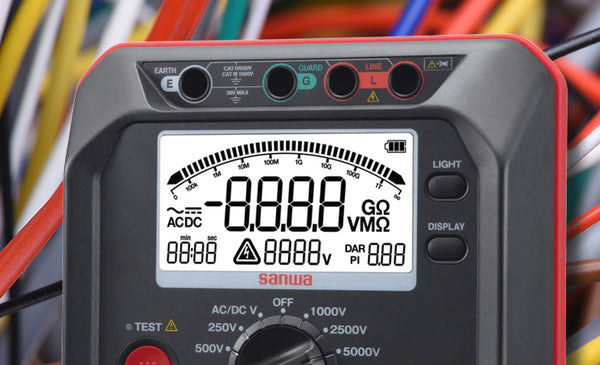
Credit: www.sanwa-america.com
When To Use A Multimeter
A multimeter is the best tool for everyday electrical and electronic tasks:
- Checking voltages in outlets, batteries, or power supplies
- Testing continuity in wires and switches
- Measuring resistance in resistors, heaters, and basic components
- Current measurement (with care, using proper range)
- Quick diagnostics for home, office, or industrial circuits
A multimeter cannot replace a megohmmeter for insulation testing but is faster and safer for basic measurements.
Limitations And Common User Mistakes
Using The Wrong Tool
One of the biggest mistakes is using a multimeter to test insulation. The reading may look fine, but insulation could still fail under high voltage. This can lead to equipment damage or safety hazards.
Another mistake is using a megohmmeter on sensitive electronic circuits. The high voltage can destroy small components.
Not Discharging Equipment
After a megohmmeter test, the equipment can hold a dangerous charge. Failing to discharge can cause electric shocks.
Overlooking Test Conditions
Insulation readings can change with temperature, humidity, and dirt. Always record test conditions and compare readings over time, not just with a single test.
Ignoring Safety Protocols
Both tools require attention to safety, but the risks are higher with a megohmmeter. Wear insulated gloves, stand on an insulated mat, and follow all procedures.
Non-obvious insight: Insulation readings that slowly decrease over months can be more dangerous than a sudden drop, as they signal progressive breakdown.

Credit: www.youtube.com
Buying Guide: Choosing The Right Instrument
Factors To Consider For Megohmmeters
- Voltage Range: Does your work require 500V, 1000V, or higher?
- Resistance Range: Choose a model that can display the values you expect.
- Display and Data Logging: Digital models may store test results for later analysis.
- Safety Ratings: Look for international safety certifications.
- Portability: Will you carry it around, or use it in a fixed location?
- Extra Features: PI, DAR, leakage current measurement can be valuable in industrial settings.
Factors To Consider For Multimeters
- Measurement Types: Do you need just voltage/resistance, or also current, capacitance, temperature?
- Accuracy: For electronics, higher accuracy is important.
- Build Quality: Rugged, drop-proof models are better for fieldwork.
- Auto-ranging: Easier for beginners; manual range gives more control.
- Display: Large, backlit screens are easier to read in dim areas.
- Safety: Look for CAT safety ratings for your environment.
Typical Price Ranges
- Megohmmeter: $100–$1000+, depending on features and voltage.
- Multimeter: $10–$300, from basic to advanced models.
Advanced Features And Modern Innovations
Megohmmeter Innovations
- Bluetooth and Wireless Data Logging: For remote monitoring and record-keeping.
- Automatic PI/DAR Calculation: For quick insulation health checks.
- Multiple Test Voltages: To suit different standards and equipment.
Multimeter Innovations
- True RMS Measurement: For accurate readings on variable waveforms.
- Non-contact Voltage Detection: For quick safety checks.
- Smart Multimeters: Some models auto-detect test type and adjust settings.
- Mobile App Integration: For saving and sharing readings.
Which Should You Own?
For most electricians and technicians, both tools are necessary. The megohmmeter is crucial for insulation and safety checks, while the multimeter handles daily troubleshooting and repairs.
Example: An electrician checks a motor with a multimeter—everything looks fine, but the motor trips breakers during operation. The real problem, invisible to the multimeter, is failing insulation. The megohmmeter finds it.
Practical Comparison Scenarios
Here are some real-world examples showing when to use each instrument.
Testing A Power Tool
- Multimeter: Check if the switch and wiring are continuous.
- Megohmmeter: Test if the insulation between live and ground is still intact.
Inspecting Old Wiring
- Multimeter: Verify that wires are not open or shorted.
- Megohmmeter: Detect if insulation is breaking down due to age or moisture.
Troubleshooting Equipment Shutdowns
- Multimeter: Measure voltage at terminals to check for supply problems.
- Megohmmeter: Assess insulation if faults persist after basic checks.
Safety Best Practices
For Megohmmeters
- Always disconnect the device under test from all power sources.
- Warn others before applying test voltage.
- Discharge equipment after testing.
- Use proper PPE—gloves, shoes, and mats.
- Never use on sensitive electronics.
For Multimeters
- Select the correct range before connecting.
- Check probe condition (no breaks or exposed metal).
- Start with higher ranges and step down if unsure.
- Observe polarity—especially on DC circuits.
- Follow CAT ratings for your measurement environment.
Industry Standards And Regulations
Electrical testing is guided by standards to ensure safety and accuracy. For insulation resistance, standards like IEEE 43, IEC 60085, and NFPA 70B specify test voltages, durations, and acceptable resistance values.
For multimeters, IEC 61010 defines safety categories (CAT I to CAT IV) for different environments. Always check your instrument meets the standard for your application.
Data Table: Typical Readings And Acceptable Values
| Application | Instrument | Expected Reading | Action if Below |
|---|---|---|---|
| Motor Winding | Megohmmeter (1000V) | > 100 MΩ (new), > 1 MΩ (old) | Do not use; replace or repair |
| Household Wire | Megohmmeter (500V) | > 10 MΩ | Inspect for moisture/damage |
| Switch Continuity | Multimeter (Ω) | < 1 Ω (closed) | Replace switch if higher |
| Resistor | Multimeter (Ω) | Within 5% of rated value | Replace if out of range |
Choosing Between Megohmmeter And Multimeter: Decision Flow
Here’s a simple decision guide:
- Need to check insulation, leakage, or safety of high-voltage equipment? Use a megohmmeter.
- Need to measure voltage, current, or basic resistance for general troubleshooting? Use a multimeter.
- Not sure? If in doubt about insulation, always choose the megohmmeter—but only on powered-off, disconnected equipment.
Real-world Example: Megohmmeter Saves The Day
A factory motor kept tripping breakers after a rainstorm. The multimeter showed normal readings—voltage, continuity, and even winding resistance seemed fine. But when a megohmmeter was used, it revealed low insulation resistance due to moisture. The wires were dried and re-insulated, preventing a costly failure and potential fire.
Lesson: The right instrument can find hidden problems and prevent disasters.
Frequently Asked Questions
What Is The Main Difference Between A Megohmmeter And A Multimeter?
A megohmmeter tests insulation resistance at high voltages to find leaks or breakdowns. A multimeter measures voltage, current, and resistance at low voltages for general electrical checks.
Can I Use A Multimeter To Test Insulation?
No. A multimeter’s low test voltage will not reveal insulation problems that only show up at high voltage. Always use a megohmmeter for insulation testing.
Is It Dangerous To Use A Megohmmeter?
It can be if safety rules are ignored. A megohmmeter applies high voltage and can give electric shocks. Always follow proper procedures and use personal protective equipment.
Which Tool Should An Electrician Buy First?
A multimeter is more versatile for everyday work and should be the first tool. A megohmmeter is essential for those working with motors, transformers, or high-voltage systems.
Where Can I Learn More About Electrical Safety And Testing?
The Occupational Safety and Health Administration (OSHA) provides reliable guidance. For more details, visit OSHA Electrical Standards.
Final Thoughts
A megohmmeter and a multimeter serve different but equally important roles in electrical work. Understanding their differences helps you choose the right tool, improve safety, and avoid hidden dangers. Never use one as a substitute for the other—respect their limits and strengths. With the correct knowledge and careful practice, you can diagnose, maintain, and repair electrical systems safely and efficiently.