When you choose a multimeter, one detail makes a huge difference in your measurements: whether it is a True RMS meter or a normal multimeter (sometimes called average-responding). If you work with electronics, home wiring, or industrial systems, this choice impacts accuracy, safety, and even the devices you can test. Many people do not realize how big this difference is—until they get unexpected results. Let’s explore what sets these two types of multimeters apart, why it matters, and how to choose the right tool for your needs.
What Is Rms And Why Does It Matter?
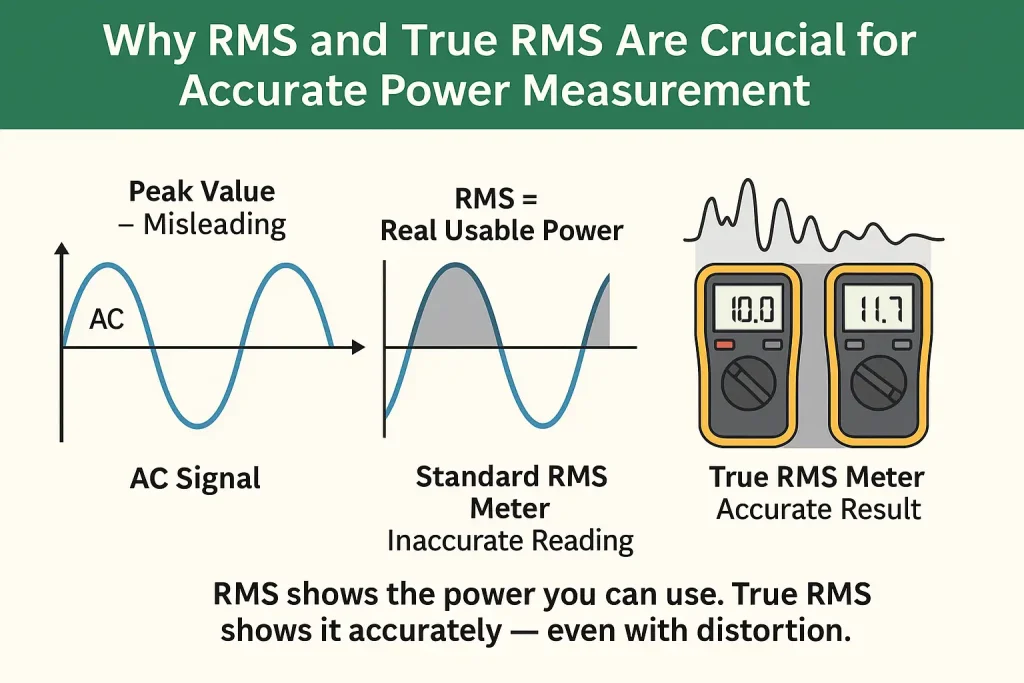
To understand the difference, you need to know what RMS means. RMS stands for “Root Mean Square.” It is a way to measure the effective value of a varying signal, especially alternating current (AC). Think of RMS as a method that tells you how much “real” power a signal can deliver. For simple signals like a perfect sine wave, calculating RMS is straightforward. But in the real world, electricity is rarely perfect.
When a device uses power, the RMS value shows the true heating effect or energy delivered. For example, when measuring the voltage from a wall outlet or an industrial machine, RMS tells you what your equipment “feels” and what your fuses and wires must handle.
Without it, you might get numbers that look right but do not reflect the actual risk or performance.
How Do Normal Multimeters Work?
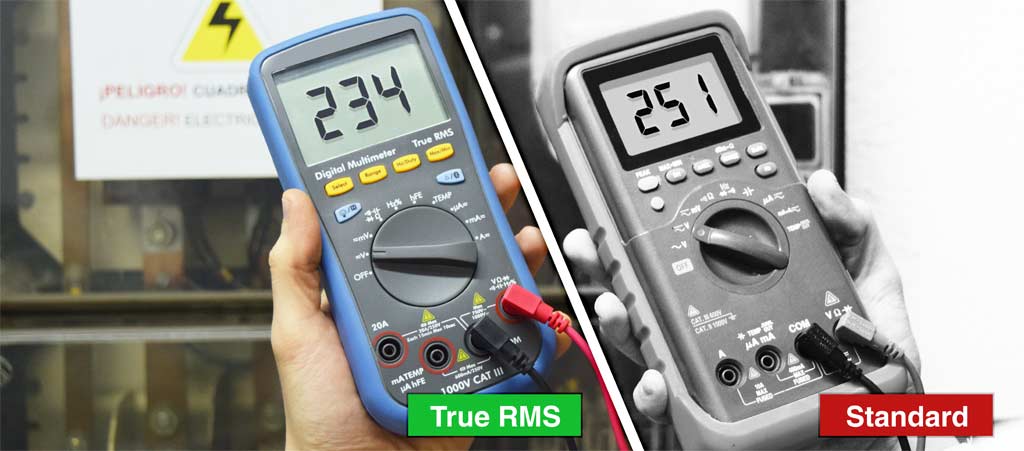
Most basic or budget multimeters are average-responding. They measure the average value of the AC signal, then apply a mathematical factor to estimate the RMS value. This works well for pure sine waves, like the power from a standard wall outlet in many countries. The meter multiplies the average reading by about 1.11 to show RMS. But this method fails when the signal is not a perfect sine wave.
For example, if you measure the output of a dimmer switch, speed controller, or a device with a complex waveform, an average-responding meter can show a value that is too low or too high. This can lead to mistakes—thinking a circuit is safe when it is not, or missing problems that could damage equipment.
What Makes A Multimeter “true Rms”?
A True RMS multimeter is designed to measure the real, effective value of any waveform—sine, square, triangle, or even messy, distorted signals. It does this by sampling the signal many times per second, squaring each value, finding the average, then taking the square root. This process is done by special electronics inside the meter.
With True RMS, you get reliable readings even when measuring signals from variable speed drives, computers, inverters, or modern lighting systems. True RMS meters are often used by professionals because they avoid dangerous errors and help diagnose complex problems.
Where Does The Difference Matter Most?
The difference between normal and True RMS meters is most important when:
- The waveform is not a pure sine wave (distorted, chopped, or has spikes)
- You work with electronic devices (computers, inverters, UPS)
- You measure signals in industrial automation (motors, drives, PLCs)
- You test lighting systems (LED, fluorescent, or dimmers)
In these cases, a normal meter can be off by 10%, 30%, or even more. That is enough to miss a serious overload or make a wrong repair decision.
Comparing True Rms And Normal Multimeters
Let’s look at a direct comparison to see how these meters differ in key ways.
| Feature | True RMS Multimeter | Normal Multimeter |
|---|---|---|
| Accuracy with Non-Sine Waves | High | Low |
| Measures Distorted Waveforms | Yes | No |
| Price | Higher | Lower |
| Best for | Professionals, advanced users | Basic household tasks |
| Works with Modern Electronics | Yes | Not reliable |
| Battery Usage | Often higher | Lower |
How Does Rms Measurement Affect Safety?
Electrical safety depends on knowing the real current or voltage in a circuit. If your meter shows a value that is too low, you might overload wires, fuses, or equipment without realizing it. This can lead to overheating, fire, or electric shock.
For example, if you use a normal multimeter to measure the current from a device with a chopped or pulsed output (like a dimmer or speed controller), the reading can be much lower than the true value. A True RMS meter gives you the correct number, so you can size wires, breakers, and protection devices safely.
Common Scenarios: When True Rms Is Essential
To make this clearer, here are some real-world examples where a True RMS meter is a must:
- Measuring power supplies for computers and servers – These use switching electronics that create complex waveforms.
- Testing the output of variable frequency drives (VFDs) – Used to control motor speed, they produce non-sine wave AC.
- Inspecting LED lighting circuits – Modern LED drivers often create unusual current waveforms.
- Troubleshooting industrial machinery – Many machines now use soft starters, inverters, and electronic controls.
- Evaluating energy usage in homes with solar panels – Inverters can produce waveforms that confuse basic meters.
- Checking power tools with speed control – The current is not a simple sine wave.
In all these cases, only a True RMS meter gives a reading you can trust.
How To Choose Between True Rms And Normal Multimeter
Selecting the right meter depends on your needs. Here’s what to consider:
1. Type Of Signals You Measure
If you only work with simple, household AC circuits (like wall outlets), a normal multimeter can be enough. But if you deal with electronics, inverters, motors, or modern lighting, True RMS is the safer choice.
2. Your Experience Level
Beginners who only check batteries, standard sockets, or car circuits may not need True RMS. Professionals, electricians, and serious hobbyists should invest in True RMS to avoid costly mistakes.
3. Budget
True RMS meters are more expensive, sometimes twice the price of basic models. But the extra cost can save much more in damaged equipment or wrong repairs.
4. Features You Need
Many True RMS meters also come with advanced features: data logging, temperature measurement, or Bluetooth connectivity. Decide if you need these or just reliable AC measurements.

Credit: www.youtube.com
Real-world Test: Sine Wave Vs. Distorted Wave
To show the difference, let’s look at a practical example.
Suppose you measure a standard 120V AC wall outlet (pure sine wave):
- Normal multimeter: 120V
- True RMS multimeter: 120V
Now, measure the output of a cheap inverter (not a pure sine wave):
- Normal multimeter: 95V (reads too low)
- True RMS multimeter: 120V (correct value)
If you rely on the normal meter, you might think the inverter is bad or unsafe, or you could misjudge how much load it can handle.
How True Rms Meters Calculate Values
True RMS meters use a digital process:
- Sample the signal at many points per second.
- Square each sample value.
- Find the average of the squared values.
- Take the square root of the average.
This method works for any waveform shape. In contrast, normal meters just average the signal, which only matches RMS for perfect sine waves.
Key Specifications To Compare
When shopping for a multimeter, look for these True RMS features:
- True RMS label: The box or manual must state “True RMS.”
- Crest factor rating: Shows how much distortion the meter can handle (common ratings: 2 to 3).
- Bandwidth: How fast a signal it can measure (important for electronics).
- Accuracy: Look for ±(percentage of reading + number of digits).
Here’s a quick comparison of typical specs:
| Specification | True RMS Multimeter | Normal Multimeter |
|---|---|---|
| AC Voltage Range | Up to 1000V | Up to 750V |
| Basic Accuracy | ±0.5% to ±1.0% | ±1.5% to ±2.5% |
| Crest Factor | 2.0 – 3.0 | 1.41 (sine wave only) |
| Bandwidth | Up to 10kHz | Up to 1kHz |
Practical Tips For Using A Multimeter
- Always check if your meter is True RMS before trusting AC readings from electronic devices.
- For safety, never touch live wires with both hands or when standing on wet surfaces.
- If your readings seem off, check the waveform. Use an oscilloscope if available.
- Replace batteries in your meter regularly—low power can affect accuracy.
- Store your meter in a dry, dust-free place to prevent errors or failures.
Common Mistakes People Make
Even experienced users sometimes make these errors:
- Assuming all meters are True RMS – Many popular models are not, especially cheaper ones.
- Measuring complex signals with a basic meter – This gives misleading results.
- Ignoring the crest factor – High crest factor signals (lots of spikes) need special meters.
- Not reading the manual – Each meter has limits; some cannot handle high frequencies or voltages.
- Using worn or damaged probes – This affects all readings, not just RMS.
Why Beginners Often Miss The Importance Of True Rms
Many people start with basic electronics or home repairs using a cheap meter. At first, everything works fine—until they try to measure something more advanced, like a modern LED light or a UPS output. The readings make no sense. Often, they think the device is broken, or the meter is faulty, not realizing the real issue is the meter’s design.
Another thing beginners miss: electricity has changed. More devices use switching power supplies or inverters. These do not produce simple sine waves, so average-responding meters are no longer enough for accurate work.
How Industry Standards Address Rms Measurement
Electrical codes and safety standards, like those from IEC or UL, now recommend True RMS meters for professional and industrial use. If you do work for clients, insurance, or inspections, using a True RMS meter may be required. For more on standards, see the Multimeter Wikipedia page.
Cost Vs. Value: Is True Rms Worth The Price?
A True RMS meter usually costs $50–$200 more than a basic meter. But the cost of a wrong diagnosis, failed repair, or damaged equipment can be far higher. For people who work with modern electronics, this is not a luxury—it’s a necessity.
For home users on a tight budget, a normal meter can work if you stick to standard AC outlets and batteries. For anyone working with electronics, motors, or solar, invest in True RMS.
Credit: www.promaxelectronics.com
How To Identify A True Rms Meter
- Look for the words “True RMS” on the device, box, or manual.
- If buying online, check the specifications or ask the seller.
- Brands like Fluke, Klein Tools, and Extech clearly label their True RMS models.
- Be careful: Some cheap meters claim to be True RMS but are not. Buy from trusted brands.
Table: When To Use Each Type
Here’s a summary to help you choose:
| Situation | True RMS Multimeter | Normal Multimeter |
|---|---|---|
| Measuring home wall outlets | Good | Good |
| Testing battery voltage (DC) | Good | Good |
| Checking motor drives or inverters | Best | Poor |
| LED or CFL lighting circuits | Best | Poor |
| Solar inverter output | Best | Poor |
| General electronics repair | Best | Limited |
Final Advice: Making The Right Choice
If you need accurate, reliable readings on any AC circuit—especially with modern electronics or in professional work—choose a True RMS multimeter. For simple household tasks, a normal meter is enough, but always know its limits. If you want just one meter for everything, go True RMS. It prevents mistakes, saves money, and keeps you safe.
Remember, the world of electricity is changing. Devices are no longer simple. Your tools must keep up, or you risk errors that can cost much more than the price of a good meter.
Frequently Asked Questions
What Does “true Rms” Really Mean?
True RMS means the meter calculates the exact heating (power) value of any AC waveform, not just sine waves. It uses a special method to measure both simple and complex signals accurately.
Can I Use A Normal Multimeter For All Tasks?
A normal multimeter is fine for DC voltage, current, and pure sine wave AC (like a wall outlet). But it is not reliable for modern electronics, inverters, or devices with complex AC signals.
Why Are True Rms Meters More Expensive?
True RMS meters use advanced electronics to sample, process, and calculate the true value of the signal. This extra technology adds to the cost, but gives much better accuracy.
How Do I Know If My Meter Is True Rms?
Check the device, box, or user manual for “True RMS.” If unsure, look up the model online or ask the seller. Trusted brands always make this clear.
What Happens If I Use The Wrong Type Of Meter?
If you use a normal meter on a complex AC signal, you can get readings that are too low or high, leading to wrong repairs, unsafe setups, or damaged equipment. Always match your meter to the job.
By understanding the real difference between True RMS and normal multimeters, you can make smarter choices, stay safe, and get results you can trust—even as technology changes.
Credit: mme-ae.com