
When you try to measure and analyze electrical signals, two tools often come up: digitizer and oscilloscope. They both show how signals change over time, but their strengths, uses, and limitations are not the same. If you work in electronics, engineering, or research, choosing the right device can save you time, money, and headaches. Many beginners confuse these two, thinking they do the same thing. Let’s clear up the differences, so you can pick the right tool for your job.
What Is A Digitizer?
A digitizer is an electronic device that converts analog signals (like voltage or current) into digital data. This data can then be stored, processed, or analyzed using a computer. Digitizers are often used in scientific research, automated test systems, and data acquisition setups.
Digitizers are built for high-speed sampling, precision, and long-term data collection. They rarely have a built-in display; instead, they send data to software for viewing and analysis. This makes them ideal when you need to collect and analyze large amounts of signal data.
Key Features Of Digitizers
- High sampling rates: Some digitizers can sample signals at rates above 10 gigasamples per second (GS/s).
- High resolution: You can find digitizers with up to 16-bit or even 24-bit resolution, which means more accurate signal capture.
- Multiple channels: Many digitizers can record data from several inputs at the same time.
- Deep memory: They often have large storage capacity, so you can record signals over long periods without losing detail.
Typical Uses For Digitizers
- Automated test equipment in factories
- Physics experiments (e.g., particle accelerators)
- Medical devices (MRI, ECG)
- Remote monitoring systems
Digitizers are usually controlled by a PC or workstation, making them flexible for custom setups.
What Is An Oscilloscope?
An oscilloscope is a device used to visually display electrical signals. It shows a graph with time on the horizontal axis and voltage on the vertical axis, letting you see how signals change in real time. Oscilloscopes are standard tools in electronics labs, repair shops, and engineering classrooms.
Oscilloscopes come with a screen, built-in controls, and often advanced features like triggering, math functions, and automatic measurements. They are built for hands-on, quick signal inspection.
Types Of Oscilloscopes
- Analog oscilloscopes: Older models that use cathode ray tubes (CRTs) to display signals.
- Digital oscilloscopes: Modern models that sample the signal and display it digitally.
- Mixed-signal oscilloscopes (MSOs): Can display both analog and digital signals.
Common Oscilloscope Features
- Sampling rates: Usually from 100 MS/s to 2 GS/s for standard models; advanced ones may reach higher.
- Resolution: Typically 8-bit or 12-bit.
- Built-in display: Shows signals directly, easy for visual analysis.
- Trigger controls: Let you capture specific events in a signal.
- Measurement tools: Easily measure frequency, amplitude, rise time, etc.
Oscilloscopes are great for troubleshooting and real-time signal observation.
Digitizer Vs Oscilloscope: Key Differences
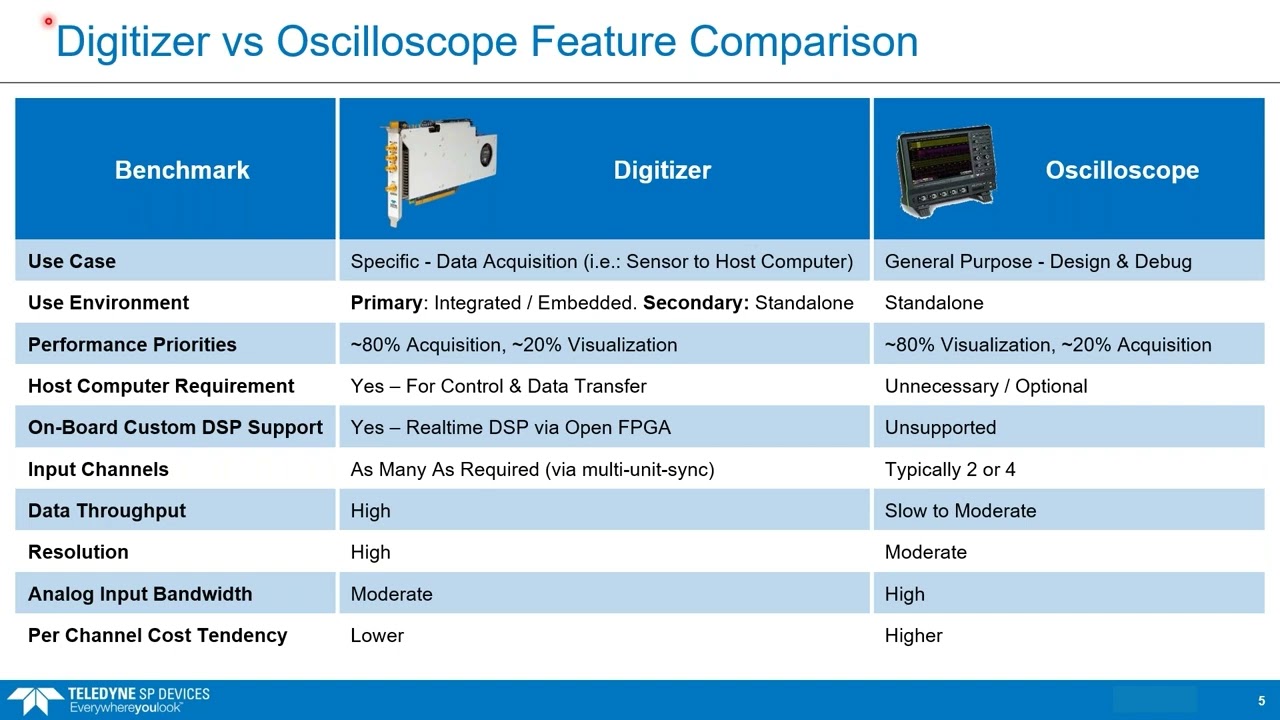
Understanding how digitizers and oscilloscopes differ helps you choose the right tool. Here’s a comparison based on important factors.
| Feature | Digitizer | Oscilloscope |
|---|---|---|
| Display | No built-in screen | Built-in screen |
| Sampling Rate | High (up to 10 GS/s+) | Moderate (up to 2 GS/s typical) |
| Resolution | High (up to 24-bit) | Moderate (8–12-bit) |
| Memory Depth | Large (millions of samples) | Limited (thousands to millions) |
| Application | Data acquisition, analysis | Visual inspection, debugging |
| User Interface | PC software | Front panel controls |
| Portability | Less portable | Portable models available |
Sampling Rate And Resolution
Digitizers often have higher sampling rates and resolution. This means they can capture faster signals and show more detail. For example, if you need to record a radio-frequency signal or a fast digital bus, a digitizer may be better.
Oscilloscopes focus on real-time display and easy measurement. Their sampling rates and resolution are usually lower, but this is fine for most troubleshooting tasks.
Memory Depth
Digitizers generally offer deeper memory, so you can record signals over a longer time without losing data. This is important for experiments where you need to capture rare events or long-duration signals.
Oscilloscopes have less memory, which limits how long you can record before overwriting old data.
User Experience
Oscilloscopes are built for hands-on use. You can connect your probe, see the signal, and adjust settings quickly. Digitizers require more setup — you need software, a computer, and often programming skills to use them fully.
Choosing Between Digitizer And Oscilloscope
Which device should you choose? It depends on your needs. Let’s break down the main factors.
Signal Type And Speed
If you deal with slow signals (like audio, sensor outputs), an oscilloscope is usually enough. For high-speed signals (RF, fast digital buses), a digitizer is often better because it can capture details that an oscilloscope might miss.
Data Analysis And Storage
Digitizers excel when you need to collect, store, and analyze large volumes of data. If your project requires long-term monitoring or advanced processing, a digitizer is the right choice.
Oscilloscopes are perfect for quick checks and troubleshooting, not for deep data analysis.
Budget And Complexity
Oscilloscopes are generally cheaper and easier to use. Digitizers can be expensive and require extra hardware and software.
For beginners, an oscilloscope is more user-friendly. If you need custom analysis or automation, consider a digitizer.
Practical Examples
- Repairing electronics: Oscilloscope is the tool of choice.
- Developing medical devices: Digitizer may be needed for precision and storage.
- Physics experiments: Digitizers are preferred for capturing fast or rare events.
- School labs: Oscilloscopes are more common for teaching basic concepts.

Credit: www.keysight.com
Real-world Applications
Let’s look at some real-world scenarios where these tools shine.
| Use Case | Best Tool | Reason |
|---|---|---|
| Testing a power supply | Oscilloscope | Quick waveform check |
| Recording ECG signals | Digitizer | High resolution and long-term recording |
| Debugging microcontroller code | Oscilloscope | Visualize digital signals |
| Capturing rare events in physics | Digitizer | Deep memory, high speed |
| Teaching basic electronics | Oscilloscope | Easy to use and visualize |
Common Mistakes When Choosing
Many beginners make errors when deciding between digitizer and oscilloscope. Here are some to watch out for:
- Ignoring memory depth: If you need to record for a long time, check memory size.
- Assuming all digitizers are better: Higher specs do not always mean better for your use.
- Not considering software needs: Digitizers often need extra software or programming.
- Overlooking portability: Oscilloscopes are easier to move and use in different places.
- Forgetting about trigger functions: Oscilloscopes have advanced triggering; digitizers may not.

Credit: vitrek.com
Non-obvious Insights
Many users overlook these important points:
- Integration with other systems: Digitizers can be part of larger automated test setups, which is crucial for industrial or research environments.
- Upgrade options: Some oscilloscopes can add more features through software updates, but digitizers often need hardware upgrades for higher specs.
These details can affect your workflow and future needs.
Digitizer And Oscilloscope: Market Trends
Demand for digitizers is growing in research and industry, especially as more systems move to automated testing. High-resolution digitizers are in demand for medical and scientific applications. Oscilloscopes remain popular for education and repair work, with newer models adding features like USB connectivity and touchscreen controls.
According to industry data, the global oscilloscope market was valued at around $2.3 billion in 2022 and is expected to grow at a steady rate. Digitizer sales are also rising, but the market is more specialized.
Summary Table: When To Use Each Tool
Here’s a quick reference for choosing between digitizer and oscilloscope.
| Requirement | Digitizer | Oscilloscope |
|---|---|---|
| Real-time display | No | Yes |
| Deep memory | Yes | Limited |
| High resolution | Yes | Moderate |
| Easy setup | No | Yes |
| Portable | No | Yes |
| Automated testing | Yes | No |
Frequently Asked Questions
What Is The Main Difference Between A Digitizer And An Oscilloscope?
The main difference is that a digitizer captures analog signals and stores them as digital data for analysis, while an oscilloscope shows signals visually in real time for quick inspection and troubleshooting.
Can I Use A Digitizer Instead Of An Oscilloscope?
You can use a digitizer for signal recording and analysis, but it lacks real-time display and easy controls. For hands-on troubleshooting or visual inspection, an oscilloscope is much more practical.
How Does Memory Depth Affect Signal Recording?
Memory depth is the amount of data a device can store. Digitizers usually offer deeper memory, which allows for longer recordings and capturing rare events. Oscilloscopes have less memory, so recordings are shorter.
Are Digitizers More Accurate Than Oscilloscopes?
Digitizers often have higher resolution and sampling rates, making them more accurate for capturing fast or complex signals. However, this accuracy depends on the specific model and application needs.
Where Can I Learn More About Digitizers And Oscilloscopes?
For a deeper technical explanation, visit Wikipedia, which covers both devices in detail.
Choosing between a digitizer and an oscilloscope is not just about specs—it’s about your workflow, needs, and future plans. Both tools are powerful in their own way. By understanding their strengths and limits, you can make smarter decisions and get the most out of your signal analysis.
Credit: www.youtube.com