When you start working with electronics, sooner or later you’ll need to measure or supply voltage and current. That’s when you come across two common instruments: the source meter and the multimeter. They might look similar at first, but their roles are very different. If you’re not sure which one to use, or what sets them apart, you’re not alone. Even experienced engineers sometimes get confused, especially with new digital models on the market.
This article will guide you through everything you need to know about source meters and multimeters. You’ll discover how each instrument works, their main uses, and what to consider when choosing one for your lab or project. Along the way, you’ll learn common mistakes beginners make and get some practical advice that’s rarely mentioned in textbooks.
What Is A Multimeter?
A multimeter is one of the most popular tools for anyone working with electricity. It combines several functions in one device: measuring voltage, current, and resistance. Most modern multimeters are digital (DMMs), but analog versions still exist.
Multimeters are found everywhere—from school labs to industrial sites. They help you check if a wire has power, measure battery voltage, or troubleshoot a faulty circuit. You simply connect the probes to your test points and read the results on the display.
There are two main types:
- Analog Multimeters – Use a needle and scale. They’re less common today but still used in some fields because they show changing signals smoothly.
- Digital Multimeters (DMMs) – Display values as numbers. They’re accurate, easy to read, and often have extra features like frequency or temperature measurement.
Core Functions
- Voltage Measurement (V): Checks the potential difference between two points.
- Current Measurement (A): Measures the flow of electric charge.
- Resistance Measurement (Ω): Shows how much a material opposes current.
- Continuity Test: Sounds a beep if a connection is good.
- Diode Test: Checks if a diode works properly.
Some advanced models also measure capacitance, frequency, or even temperature.
Typical Applications
- Troubleshooting household appliances
- Checking batteries
- Repairing electronic devices
- Testing car electrical systems
Multimeters are great for quick checks and basic diagnostics. They’re affordable, portable, and simple to use. But they have limitations, especially for advanced electronics testing.
What Is A Source Meter?
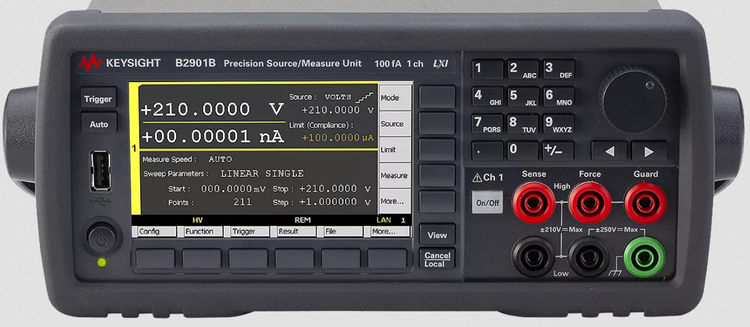
A source meter (often called a Source Measure Unit or SMU) is a high-precision instrument that can both source (supply) and measure voltage or current at the same time. This makes it much more powerful than a multimeter for detailed testing.
Source meters are often used in research labs, semiconductor testing, and advanced product development. They’re essential for characterizing components like transistors, LEDs, solar cells, and sensors. Unlike a multimeter, a source meter can apply a controlled voltage or current to a device under test and then measure how it responds.
Core Functions
- Voltage Sourcing: Supplies a precise voltage and measures the resulting current.
- Current Sourcing: Supplies a precise current and measures the resulting voltage.
- Sweep Testing: Automatically varies voltage or current over a range and records the response.
- Four-Wire (Kelvin) Measurements: Reduces errors from wire resistance, improving accuracy for small signals.
- Automated Sequences: Runs complex tests without manual input.
Typical Applications
- Measuring I-V (current-voltage) curves of semiconductors
- Testing the efficiency of solar panels
- Characterizing sensor behavior under different conditions
- Failure analysis in research labs
Source meters are highly accurate and versatile, but they’re also more expensive and complex than multimeters. They’re designed for professionals who need precise data, not just a simple measurement.
.png)
Credit: www.datatec.eu
Key Differences Between Source Meter And Multimeter
At first glance, both devices can measure voltage and current. But their true capabilities are very different. Here’s a detailed comparison to help you understand where each tool shines.
| Feature | Source Meter | Multimeter |
|---|---|---|
| Measurement Functions | Voltage, current, resistance (with high accuracy); can also source voltage/current | Voltage, current, resistance (basic); cannot source |
| Sourcing Capabilities | Yes (precisely supplies voltage or current) | No |
| Accuracy | Very high (up to 6½ digits) | Good for general use (3½ to 4½ digits) |
| Typical Uses | Component testing, R&D, semiconductor analysis | Basic troubleshooting, field work, maintenance |
| Automation | Supports scripting, automated tests | Mostly manual operation |
| Price Range | High (often $2,000+) | Low to medium ($10–$500+) |
Main Takeaways
- Source meters can both supply and measure electrical signals, while multimeters only measure.
- Source meters are much more precise and can automate complex tests.
- Multimeters are affordable, portable, and ideal for everyday troubleshooting.
How Each Device Works
Understanding how these tools operate can help you avoid mistakes and choose the right one for your needs.
How A Multimeter Works
A multimeter measures electrical properties by connecting to a circuit. For voltage, it’s placed in parallel; for current, in series. Inside, an analog-to-digital converter (ADC) turns signals into numbers. Switches and protection circuits handle different ranges and types of measurements.
Most DMMs have fuses to protect against overload. Some also have auto-ranging, which selects the best measurement range for you.
Example: If you want to check a car battery, set the dial to DC voltage, touch the probes to the terminals, and read the value. It’s quick and easy.
How A Source Meter Works
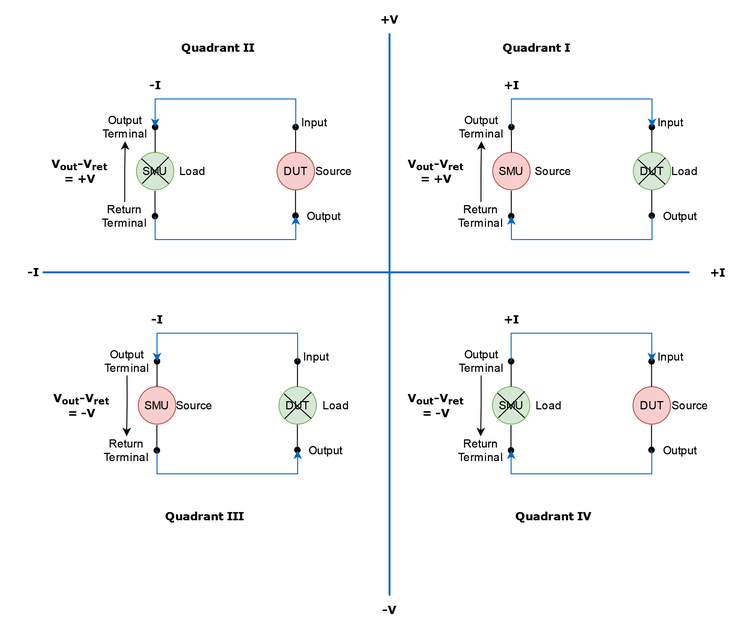
A source meter has both a power supply and a measurement circuit inside. When you program it to supply a voltage, it controls the output exactly and measures the resulting current. If you set it to source current, it adjusts the voltage automatically to maintain that current.
Advanced source meters use feedback loops and precision amplifiers to keep outputs stable. They often connect to computers for automated testing and data logging.
Example: If you want to test a solar cell, you can use a source meter to sweep the voltage from 0 to 2 volts. The meter measures the current at each step, creating an I-V curve that shows how the cell performs.
Practical Scenarios: When To Use Each Tool
Choosing between a source meter and a multimeter depends on your task. Here’s when each tool is the best choice.
Ideal Situations For A Multimeter
- Checking if an outlet has power
- Measuring the voltage of batteries
- Testing if a fuse is blown
- Quickly finding faults in a circuit
Multimeters are your “go-to” tool for everyday checks and repairs. They’re small enough to fit in your pocket and simple to use, even for beginners.
Ideal Situations For A Source Meter
- Characterizing a new semiconductor device
- Measuring leakage current in insulation materials
- Testing precision resistors or sensors
- Running automated tests over long periods
Source meters are for advanced analysis and research. If your work involves product development, quality control, or scientific experiments, a source meter is often essential.
Common Overlaps And Mistakes
Some beginners try to use a multimeter for advanced tests, like measuring the leakage current of a tiny sensor. But a typical DMM can’t measure such small values accurately. On the other hand, using a source meter for simple voltage checks is overkill and wastes time.
Non-obvious tip: If you need to measure current below 1 microamp (1 μA), a source meter is usually the only reliable choice.
Key Specifications: What To Look For
When buying or using these instruments, certain specs matter more than others. Here’s what you should pay attention to—and why.
Important Multimeter Specifications
- Accuracy: Look for ±(percentage of reading + digits). For most work, 0.5% is enough.
- Display Digits: More digits mean more detail, but also more cost.
- Range: Make sure the voltage and current ranges fit your needs.
- Input Protection: Good DMMs have fuses and surge protection.
- Auto-ranging: Saves time by picking the right range automatically.
- Extra Features: Some models add temperature, capacitance, or frequency modes.
Common mistake: Beginners often ignore safety ratings. Always check for CAT II, III, or IV ratings if you’ll work with mains voltage.
Important Source Meter Specifications
- Source Accuracy: How close the output matches the set value.
- Measurement Accuracy: How precisely it measures current and voltage.
- Output Range: Voltage and current limits (e.g., ±20 V, ±1 A).
- Resolution: How small a change it can detect or supply.
- Speed: How fast it can take measurements or change settings.
- Four-Wire Measurement: Essential for low-resistance or low-current tests.
- Automation/Remote Control: Useful for lab setups.
Non-obvious tip: If you plan to test new materials or devices, check if the source meter supports low current measurements (down to picoamps) and has low noise.
Real-world Examples
Let’s see how these differences play out in practice.
Example 1: Testing A Resistor
- With a Multimeter: Set to resistance mode, touch the probes to the resistor, and read the value.
- With a Source Meter: Can supply a known current, measure voltage, and calculate resistance with much higher accuracy. Also useful for very low-value resistors.
Example 2: Characterizing A Diode
- With a Multimeter: Can check if the diode conducts in one direction, but not much more.
- With a Source Meter: Can sweep voltage and measure the resulting current, producing a full I-V characteristic curve. This is important for research and design.
Example 3: Checking A Power Supply
- With a Multimeter: Measures the output voltage or current.
- With a Source Meter: Can simulate a load, measure response, and even test the stability of the supply under different conditions.
Source Meter And Multimeter: Pros And Cons
To make it easier to choose, here’s a quick summary.
| Feature | Source Meter Pros | Source Meter Cons | Multimeter Pros | Multimeter Cons |
|---|---|---|---|---|
| Accuracy | Extremely high, lab-grade | Overkill for basic tasks | Sufficient for most fieldwork | Not precise for small values |
| Functionality | Sources and measures | Complex to operate | Simple and versatile | Cannot source signals |
| Price | Very expensive | High initial cost | Affordable | Fewer features |
| Size & Portability | Large, bench-top device | Not portable | Handheld, portable | Limited to simple checks |
| Learning Curve | Steep, needs training | Harder for beginners | Easy to learn | Easy to misuse for advanced tasks |
Choosing The Right Tool For Your Needs
With so many options, it’s important to match the tool to your application.
When A Multimeter Is Enough
If your work involves:
- Home or car repairs
- Checking batteries, outlets, or fuses
- Simple electronics projects
- Basic troubleshooting
A good digital multimeter will cover almost everything. Choose one with enough accuracy, a clear display, and good safety ratings. You don’t need to spend a fortune—many reliable models are available under $100.
When You Need A Source Meter
If your work involves:
- Research and development
- Testing semiconductors, sensors, or new materials
- Measuring very small currents or voltages
- Automating complex tests
A source meter is the right choice. It’s a major investment, but it saves time and provides data you simply can’t get with a multimeter. Look for models from well-known brands and check if they support computer control for automation.
Why Not Use Both?
In many labs, you’ll find both tools side by side. Technicians use the multimeter for quick checks, and the source meter for serious experiments. If your budget allows, having both gives you maximum flexibility.
Pro tip: Some advanced source meters can double as high-end multimeters, but not the other way around.
Safety Tips And Best Practices
Working with electrical instruments always carries some risk. Here are some practical safety reminders:
- Always check your instrument’s rating before connecting to high voltage or current.
- Inspect the probes and cables for damage before each use.
- Never try to measure current by connecting across a voltage source—this can blow the fuse or damage the device.
- Use the right settings: Set your multimeter or source meter to the correct measurement or sourcing mode.
- Understand the limitations: Don’t use a multimeter for measurements below its accuracy or resolution limits.
- Ground yourself (using an anti-static wrist strap) when working with sensitive electronics.
- Read the manual: Each model is a bit different; don’t guess if you’re unsure.
Non-obvious insight: Many accidents happen when users forget to switch back from current measurement to voltage measurement mode. Always check your settings before connecting to a circuit.
Credit: www.keysight.com
Evolution And Future Trends
Electronics testing is evolving rapidly. Modern source meters now include touchscreens, Wi-Fi, and scripting. Some multimeters are adding Bluetooth, data logging, and integration with smartphones. The line between test instruments is blurring, but the core differences remain.
In the future, expect even more automation and cloud-connected test tools. Engineers will spend less time taking readings and more time analyzing data. If you’re starting a career in electronics, learning to use both multimeters and source meters will open new opportunities.
For deeper technical details, you can explore the Wikipedia page on Source Measure Units.
Frequently Asked Questions
What Is The Main Difference Between A Source Meter And A Multimeter?
The main difference is that a source meter can both supply (source) and measure voltage or current, while a multimeter can only measure. Source meters are designed for high-precision testing and can automate complex tests, making them ideal for research and development. Multimeters are simpler tools used for basic troubleshooting and maintenance.
Can A Multimeter Replace A Source Meter For Advanced Testing?
No. A multimeter is not accurate or flexible enough for advanced tests like I-V curves or low-current measurements. Source meters can handle these tasks with high precision and can also automate tests, which multimeters cannot do. For detailed component analysis, a source meter is required.
Is It Safe To Use A Multimeter On High-voltage Circuits?
It depends on the multimeter’s safety rating. Make sure your device is rated for the voltage and category (CAT II, CAT III, or CAT IV) you’re working with. Always follow safety guidelines, inspect your probes, and never exceed the recommended limits.
Why Are Source Meters So Expensive Compared To Multimeters?
Source meters are expensive because they use high-precision components, offer both sourcing and measuring functions, and often include advanced features like low-noise design, four-wire measurement, and automation. They’re built for research and critical testing, not just basic checks.
Can I Use Both A Source Meter And A Multimeter In The Same Experiment?
Yes. Many labs use both instruments. For example, you might use a source meter to supply current and measure voltage precisely, while a multimeter monitors another part of the circuit. Just be careful to avoid ground loops or connecting the instruments incorrectly.
Choosing the right instrument makes your work easier, safer, and more accurate. Whether you’re a student, technician, or engineer, understanding the strengths and limits of both the source meter and the multimeter is a skill that will serve you for years to come.
Credit: www.keysight.com