Testing a ballast with a multimeter can seem challenging if you’ve never done it before. Ballasts are hidden inside light fixtures, and their problems often mimic other electrical issues. But knowing how to test a ballast is a critical skill for anyone who works with fluorescent or HID lighting.
A faulty ballast can cause flickering, buzzing, or complete failure of the light. This guide will show you, step by step, how to safely and accurately test a ballast using a multimeter—even if you’re a beginner. You’ll also learn how to spot subtle signs of ballast failure and avoid common testing mistakes.
By the end, you’ll have the confidence to diagnose lighting issues with professional accuracy.
Understanding Ballasts: What They Do And Why They Matter
A ballast is an electrical device that regulates the current to fluorescent and HID lamps. Without a ballast, these lamps would draw too much current and burn out quickly. Ballasts come in two main types: magnetic and electronic. Each type has a different internal structure and failure pattern.
If a ballast fails, your light might not turn on, might flicker, or might make a humming sound. Many people replace lamps or starters, only to find the problem returns because the real issue is the ballast. Testing the ballast directly saves you time and money.
When Should You Test A Ballast?
Not every lighting problem comes from the ballast. Before you open up a fixture, watch for these signs:
- The lamp flickers even after replacement
- You hear buzzing or humming from the fixture
- Lights turn off after a short time
- Lamp ends appear blackened
- There is a burning smell or visible damage
If you see any of these, testing the ballast is the logical next step.

Credit: www.sunmory.com
Safety First: Preparing To Test
Testing a ballast involves working with electricity. Even when turned off, ballasts can hold a charge. Safety is critical. Here’s what you must do:
- Turn off power at the breaker, not just the switch.
- Wait at least 5-10 minutes for capacitors to discharge.
- Use insulated tools and gloves.
- Double-check power is off with a non-contact voltage tester.
- Keep your workspace dry and well-lit.
Never rush. Ballast testing is safe if you respect these steps.
Tools And Materials You’ll Need
Before you start, gather these items:
- A digital multimeter (with continuity, resistance, and voltage settings)
- Insulated screwdriver
- Wire cutters/strippers
- Needle-nose pliers
- Safety gloves and goggles
- Ladder (if working on ceiling fixtures)
- Replacement ballast or lamp (for confirmation tests)
A high-quality multimeter is important. Fluke, Klein, and Extech are reliable brands.
Getting Access To The Ballast
Most ballasts are inside the fixture behind a cover plate. Here’s how to reach them:
- Remove the lamp(s) gently.
- Unscrew and remove the fixture cover.
- Locate the ballast—a rectangular or cylindrical component with wires coming out.
- Identify the wiring diagram (often printed on the ballast).
Take a photo of the wiring before disconnecting anything. This helps you reconnect everything correctly later.
Identifying Ballast Types
It’s important to know which ballast you’re testing. The two main types are:
- Magnetic ballasts: Heavier, often with a core and coil, used in older fixtures.
- Electronic ballasts: Lighter, use solid-state electronics, found in newer fixtures.
Here’s a quick comparison:
| Type | Weight | Flicker | Noise | Age Group |
|---|---|---|---|---|
| Magnetic | Heavy | Common | Buzzing possible | Pre-2000s |
| Electronic | Light | Rare | Silent | 2000s-present |
Knowing the type helps you choose the correct test method.
How To Test A Magnetic Ballast With A Multimeter
Step 1: Disconnect The Ballast
- Ensure all power is off.
- Disconnect the ballast wires from the lamp holders (tombstones) and power lines.
- Label or photograph connections for reassembly.
Step 2: Set The Multimeter
- Turn the multimeter to the ohms (Ω) setting.
- If your multimeter is auto-ranging, it will select the range automatically. If manual, set to the lowest resistance range (typically 200Ω).
Step 3: Test For Continuity
- Place one probe on each wire pair (input and output) of the ballast.
- You should see low resistance (a few ohms) between the wires. This means the internal coil is intact.
- If the multimeter shows infinite resistance (OL or open line), the coil is broken, and the ballast is bad.
Step 4: Check For Shorts
- Place one probe on a ballast wire and the other on the metal case.
- The multimeter should show infinite resistance. Any continuity means a short to the case—a dangerous situation.
Step 5: Measure Coil Resistance
- Compare your reading to the ballast’s rated resistance (often in the datasheet or on the label).
- For most magnetic ballasts, coil resistance is between 0.5 and 2 ohms.
- A reading much higher or lower means the ballast is faulty.
Example
If your ballast label says the coil should read 1. 2Ω, and your multimeter shows 10Ω or OL, the ballast is failing.
How To Test An Electronic Ballast With A Multimeter
Electronic ballasts are more complex. They use electronic circuits, so simple resistance tests may not always show a problem. But you can still check for basic faults.
Step 1: Visual Inspection
- Look for burn marks, melted plastic, or swollen components. These are clear signs of failure.
Step 2: Check For Continuity
- Set your multimeter to the continuity setting.
- Test between input and output wires. Electronic ballasts sometimes show no continuity by design—this is normal.
- If you see a dead short (0 ohms), the ballast is definitely bad.
Step 3: Test Input Voltage (with Power On)
This step should only be done if you are comfortable and experienced.
- Restore power to the fixture.
- Set the multimeter to AC voltage.
- Carefully probe the input terminals to see if the correct voltage is reaching the ballast (usually 120V or 277V).
- If there is input voltage, but the lamp does not light, the ballast is likely bad.
Caution: This is a live test. Only attempt if you know electrical safety.
Step 4: Output Voltage Check
- Turn the power off.
- Place probes on the lamp output wires.
- If you see voltage spikes or no voltage at all, the ballast is faulty.
Example
Suppose you measure 0V on the output side while the input is 120V AC and the lamp is good. The electronic ballast is not functioning.
Common Ballast Testing Mistakes
Even experienced electricians sometimes make these errors:
- Not turning off power at the breaker—using only the switch is unsafe.
- Testing the ballast with lamps still connected—can give misleading readings.
- Forgetting to discharge the ballast—risk of shock.
- Not comparing readings to the ballast’s own datasheet—ballasts vary.
- Using a cheap or faulty multimeter—results may be unreliable.
Interpreting Test Results
After testing, you’ll get one of several outcomes:
- Low resistance or continuity: Ballast coil is likely good (for magnetic).
- No continuity (OL): Open circuit, ballast is bad.
- Short to case: Replace ballast immediately—safety risk.
- Correct input, no output: Electronic ballast failure.
If you’re unsure, compare your results to the manufacturer’s specs. Many datasheets are available online.

Credit: www.carparts.com
What To Do If The Ballast Fails
If your ballast fails any of these tests, it must be replaced. Continuing to use a failed ballast is unsafe and wastes energy.
Steps To Replace A Ballast
- Buy a compatible replacement (match voltage, lamp type, and wattage).
- Turn off all power.
- Remove the old ballast.
- Wire the new ballast using your photo as a guide.
- Secure all connections.
- Reinstall lamps and cover.
- Restore power and test the fixture.
For most home users, upgrading from magnetic to electronic ballasts is a smart move. Electronic ballasts are more efficient, quieter, and last longer.
Testing Ballasts Without Removing Them
Sometimes, you need to test a ballast without disconnecting everything. This is possible, but less accurate.
- Set the multimeter to voltage.
- With the lamp removed, test across the lamp holder contacts.
- If you see the expected voltage (usually 100-200V for a fluorescent ballast), the ballast is working.
- If you see zero voltage, the ballast or power supply is bad.
This method works best as a quick check, not a full diagnosis.
Signs That Mimic Ballast Failure
Many lighting problems look like ballast failure but aren’t. Always check these first:
- Lamp age: Old lamps can flicker or fail.
- Loose wiring: Can cause intermittent problems.
- Bad starters: Common in older fixtures.
- Faulty sockets (tombstones): Prevents current flow.
Here’s a quick comparison of symptoms:
| Problem | Symptom | Ballast Needed? |
|---|---|---|
| Old Lamp | Flicker, no light | No |
| Loose Wiring | Intermittent light | No |
| Bad Starter | Stays dark, flickers | No |
| Ballast Failure | Humming, burning smell, no output | Yes |
Testing the ballast directly avoids wasted time.
The Role Of Ballast Starters
Some magnetic ballasts use a starter—a small cylinder that helps the lamp ignite. If your fixture has a starter, always check it first. A bad starter can mimic a bad ballast. Replacing starters is cheap and easy.
Advanced Testing: Capacitance And Leakage
Professional electricians sometimes measure capacitance and leakage current in ballasts, especially in large buildings. This requires advanced meters and is not needed for most home users, but knowing about it can help you understand more complex lighting systems.
Environmental And Energy Considerations
Replacing failed ballasts is a chance to save energy. Electronic ballasts use up to 30% less power and last longer than magnetic ones. If you manage many fixtures, upgrading can reduce your electricity bills and maintenance costs.
Proper Disposal Of Old Ballasts
Some ballasts, especially older magnetic ones, contain PCBs (polychlorinated biphenyls)—hazardous chemicals banned in many countries. Always check the label. If it says “No PCBs,” it’s safe to dispose with normal electrical waste. If not, take it to a hazardous waste center.
For more on PCB regulations, visit the EPA PCB website.
Practical Tips For Accurate Ballast Testing
- Always check wiring diagrams—ballasts can have unusual wiring.
- Replace lamps with known good ones before blaming the ballast.
- Label all wires before disconnecting.
- Keep a record of test readings for future reference.
- If multiple fixtures fail at once, check for power supply issues.
When To Call A Professional
If you’re ever unsure, or if tests involve live circuits, it’s best to call a licensed electrician. Ballast replacement is routine for pros and can often be done quickly and safely.
Frequently Asked Questions
What Is The Safest Way To Test A Ballast?
The safest way is to turn off power at the breaker, wait for the ballast to discharge, and use a multimeter to test for continuity and resistance. Never test a ballast with live power unless you have electrical experience.
Can A Ballast Be Partially Bad?
Yes, a ballast can work intermittently or only with some lamps. Partial failures often cause flickering, slow starts, or buzzing. Testing with a multimeter can confirm if the ballast is the problem.
How Long Do Ballasts Usually Last?
Most ballasts last between 10 and 20 years, depending on use and quality. Electronic ballasts tend to last longer than magnetic ones. Excess heat, power surges, and poor ventilation can shorten lifespan.
Are Electronic Ballasts Better Than Magnetic Ballasts?
Electronic ballasts are more efficient, quieter, and last longer. They also reduce flicker and save energy. For most applications, upgrading to electronic is recommended when replacing a failed ballast.
Do All Fluorescent Fixtures Use Ballasts?
Yes, all fluorescent and HID fixtures need a ballast to regulate current. Some newer LED “tubes” are designed to bypass the ballast, but for traditional fluorescent lamps, a ballast is essential.
Testing a ballast with a multimeter might seem technical, but with care and the right steps, it’s a straightforward task. By understanding your lighting system and following these guidelines, you can quickly diagnose and fix most common lighting issues—saving time, money, and frustration.
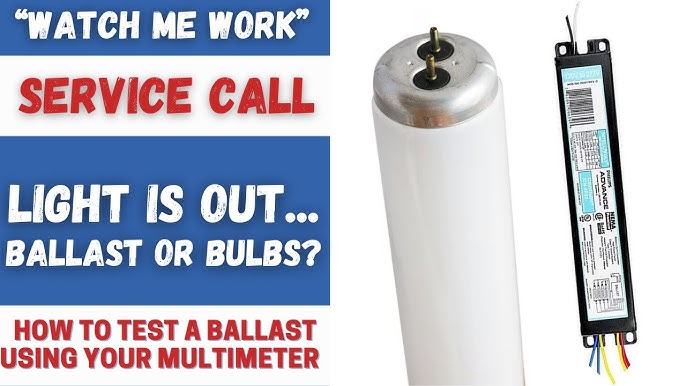
Credit: www.youtube.com