When it comes to test equipment for electricians, HVAC technicians, and field engineers, two brands often stand out: UEi and Fluke. Both are well-known for their range of measurement tools, including multimeters, clamp meters, and specialized testers. But which one is better for your needs? The answer is not always simple. Choosing between UEi and Fluke depends on your budget, application, and how much reliability and precision you require. In this article, you’ll discover how UEi and Fluke compare in design, accuracy, durability, price, support, and more. Whether you are a professional or a serious DIYer, understanding the differences will help you make a smarter investment.
Understanding Uei And Fluke
Before comparing the features, it’s important to know what UEi and Fluke represent in the world of test instruments.
UEi Test Instruments, founded in the UK and now based in the US, is recognized for practical, budget-friendly tools. The brand focuses on providing reliable performance at a lower price. They offer a wide range of equipment, such as clamp meters, HVAC tools, manometers, and gas detectors. Many HVAC professionals know UEi for its yellow and black tools.
Fluke Corporation, started in 1948 in the US, is a global leader in electrical testing and measurement. Fluke is famous for its rugged build quality, high accuracy, and innovations in digital multimeters and electrical testers. Professionals across many industries trust Fluke when precision and safety are critical.
The reputation of these brands influences how technicians and companies choose their equipment. Let’s look deeper at the specifics.
Product Range And Specialization
The first thing to consider is what type of tools you need and how each brand’s lineup matches those needs.
Uei Product Focus
UEi produces:
- Clamp meters (budget and mid-range models)
- Multimeters (digital, auto-ranging, and basic analog types)
- Combustion analyzers for HVAC and heating professionals
- Gas leak detectors and manometers
- Thermometers (IR and contact)
- Specialty HVAC tools (pressure testers, CO detectors)
UEi tools are often bundled with accessories like thermocouples, leads, and carrying cases. Their products focus on value and ease of use for technicians who need reliability, but not always the highest accuracy or advanced features.
Fluke Product Focus
Fluke offers:
- Digital multimeters (from entry-level to advanced, including True RMS and wireless models)
- Clamp meters with advanced features
- Insulation testers
- Thermal imagers
- Electrical installation testers
- Process calibration tools
- HVAC-specific instruments
Fluke’s range is wider and covers more advanced needs. Many Fluke meters are category-rated for industrial work and have features like data logging, wireless connectivity, and advanced troubleshooting modes.
Product Lineup Comparison
Here’s a quick look at how each brand’s product range compares:
| Category | UEi | Fluke |
|---|---|---|
| Digital Multimeters | Good (basic to mid-range) | Excellent (basic to advanced) |
| Clamp Meters | Strong presence | Industry leader |
| HVAC Tools | Extensive selection | Solid but less variety |
| Process Calibrators | Limited | Comprehensive |
| Thermal Imagers | Few models | Wide range |
Insight: If your main work is HVAC, UEi often covers all your needs with targeted instruments. For advanced electrical and industrial tasks, Fluke’s lineup is more complete.
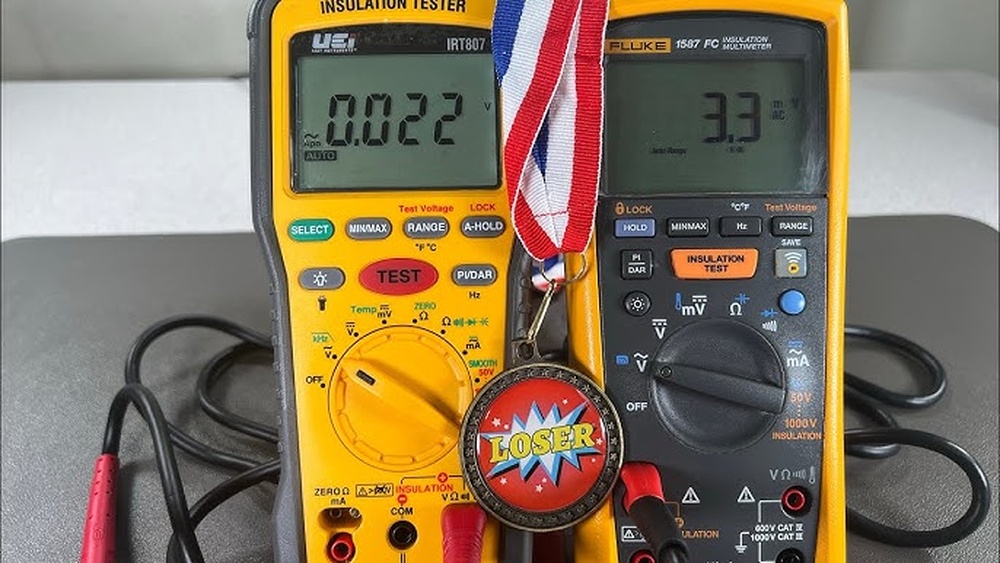
Build Quality And Durability
A test meter’s lifespan depends on how well it survives daily use, accidental drops, and harsh environments.
Uei Construction
UEi tools are known for their lightweight and practical design. The cases are usually molded plastic, sometimes with a rubber grip or boot for extra protection. Many UEi meters can handle the occasional fall, but they are not as robust as Fluke’s. They are best for indoor or light field use.
Fluke Construction
Fluke’s reputation comes from their over-engineered ruggedness. Their meters feature:
- Thick rubber holsters to absorb impact
- Solid internal construction to prevent board damage
- High-quality input jacks and dial switches
- Water and dust resistance (on many models)
Fluke meters are regularly “drop-tested” from 1–3 meters. Many users report their Fluke tools working perfectly after years of heavy use—even after falls from ladders or trucks.
Durability Comparison
| Feature | UEi | Fluke |
|---|---|---|
| Drop Resistance | Fair (light to moderate) | Excellent (heavy-duty) |
| Ingress Protection | Limited | Common on pro models |
| Build Materials | Plastic, some rubber | Thick plastic, full rubber |
| Long-term Reliability | Good in normal use | Outstanding, even in tough environments |
Tip: If you work in rough areas or need a tool that survives years of abuse, Fluke is the safer choice. For careful indoor use or occasional field trips, UEi can be sufficient.
Accuracy And Measurement Performance
When testing voltage, current, or temperature, accuracy can be critical—especially for troubleshooting sensitive equipment.
Uei Accuracy
UEi meters are accurate enough for most residential and light commercial work. Their digital multimeters usually have basic True RMS functionality and meet general CAT II or CAT III safety ratings. However, their accuracy tolerance is often wider than Fluke’s.
For example, a typical UEi multimeter might have a DC voltage accuracy of ±0. 5% + 2 digits. For HVAC measurements, this is usually fine.
Fluke Accuracy
Fluke is famous for precise measurement. Their meters are routinely used in laboratories and for industrial maintenance. Many Fluke models offer:
- True RMS readings for accurate AC measurements
- High basic accuracy (e.g., ±0.09% or better on flagship models)
- Low burden voltage for current measurement
- Advanced filters to reduce noise
This level of accuracy helps when checking sensitive electronics or troubleshooting complex systems.
Why Accuracy Matters
- For checking line voltage in a home, both UEi and Fluke are sufficient.
- For calibrating medical or industrial equipment, Fluke’s higher accuracy is required.
Non-obvious Insight: Some technicians forget that even small accuracy differences can matter in control circuits or when measuring milliamp signals. If you do automation or process controls, Fluke’s numbers matter.
Features And Ease Of Use
Modern meters come with many extra features. Some are essential; others are “nice to have. ”
Uei Features
UEi meters often include:
- Auto-ranging for quick operation
- Backlit displays for dark areas
- Basic data hold and min/max
- Integrated temperature measurement (with included thermocouple)
- Simple interface with clear buttons
These features suit technicians who want a straightforward tool. UEi often bundles extra probes or adapters, making the first purchase easier.
Fluke Features
Fluke meters go further, often including:
- True RMS as standard
- LoZ (low impedance) modes to prevent ghost readings
- Data logging and storage (on higher-end models)
- Wireless connectivity (Fluke Connect system)
- Multiple display modes (bar graphs, dual readouts)
- Advanced safety features (fused inputs, warning beeps)
Fluke’s user interface is often more refined, with smooth rotary switches and tactile buttons.
User Experience Example
A UEi clamp meter might require a few extra steps to select the right range or hold a value. A Fluke might do this automatically, saving time on the job.
Pro Tip: If you value speed and advanced troubleshooting, Fluke’s extra features are worth the cost. For basic electrical tasks, UEi covers most needs.
Safety Ratings And Certifications
For anyone working with electricity, safety is not optional. The risk of arc flash, shock, or meter failure is real.
Uei Safety
Most UEi meters are CAT II or CAT III rated, suitable for residential and light commercial work. They meet basic UL or CE standards. Input protection is good, but not designed for high-energy industrial panels.
Fluke Safety
Fluke sets the industry standard for safety:
- CAT III and CAT IV ratings on many models
- Double-insulated cases
- High rupture fuses
- Input protection circuits for overloads and surges
- Third-party certification (UL, CSA, TUV, etc.)
Fluke meters are often required by industrial plants because their safety is proven, not just claimed.
Non-obvious Insight: Many job sites and safety officers only allow CAT III or higher-rated meters, especially around 480V or higher circuits. Fluke’s certification can be essential for compliance.
Price And Value For Money
Budget is a big factor for both individuals and companies. How much does the extra quality cost?
Uei Pricing
UEi’s main advantage is affordability. Most of their clamp meters and multimeters cost between $40 and $150. Even their advanced HVAC analyzers are priced lower than Fluke’s equivalents. UEi’s included accessories make the initial kit more complete.
Fluke Pricing
Fluke’s prices reflect their build, accuracy, and safety. Entry-level Fluke meters start around $80, but pro-grade models can reach $300–$600 or more. Clamp meters and thermal imagers are also more expensive. Accessories are usually sold separately.
Value Comparison
| Product Type | UEi Typical Price | Fluke Typical Price |
|---|---|---|
| Basic Multimeter | $40–$70 | $70–$150 |
| Clamp Meter | $60–$120 | $120–$350 |
| Advanced HVAC Analyzer | $300–$600 | $800–$1,200 |
Tip: If you are just starting out or need to equip multiple technicians, UEi saves money. For long-term reliability and lower replacement costs, Fluke is an investment.
Warranty And Customer Support
Even the best tools can fail. How companies handle problems is important.
Uei Support
UEi offers 1–3 year warranties on most products. Support is US-based, with repair and calibration centers. Warranty service is generally fast, but some users report mixed experiences.
Fluke Support
Fluke is famous for long warranties, often 3 years or even a lifetime on certain meters. Support is global, with service centers in many countries. Fluke offers calibration, repair, and even tool upgrades.
Non-obvious Insight: If you plan to keep your meter for many years or need calibration certificates for compliance, Fluke’s after-sales service is a major advantage.

Credit: www.homedepot.com
Popular Models Compared
Let’s look at two common tools side by side.
Uei Dm525 Vs. Fluke 117 Multimeter
- UEi DM525: Auto-ranging, True RMS, temperature input, backlight, CAT III 600V, about $70.
- Fluke 117: Auto-ranging, True RMS, LoZ mode, VoltAlert (non-contact voltage), CAT III 600V/CAT IV 300V, about $150.
Verdict: The Fluke 117 is more robust and safer for tricky environments. The UEi DM525 gives similar core features for half the price, but without Fluke’s advanced safety and build.
Uei Dl429b Vs. Fluke 325 Clamp Meter
- UEi DL429B: 600A AC/DC, True RMS, temperature, microamps, data hold, $120–$140.
- Fluke 325: 400A AC/DC, True RMS, temperature, continuity, CAT III 600V/CAT IV 300V, $250–$300.
Verdict: UEi packs more features for the price, but Fluke offers higher safety and more reliable construction.
Who Should Choose Uei?
UEi is ideal for:
- HVAC technicians needing affordable, specialized tools
- Electricians working mainly in residential or light commercial settings
- Students and apprentices starting out
- DIYers who want solid performance without a big investment
If you rarely work in harsh environments or on high-energy systems, UEi’s value is hard to beat.
Who Should Choose Fluke?
Fluke is best for:
- Industrial electricians needing CAT III/IV safety and high accuracy
- Engineers in labs or process industries
- Technicians who need tools to last 10+ years
- Companies with strict safety or compliance rules
If your job depends on your meter every day—or your safety depends on it—Fluke is the smart investment.
Real-world User Experiences
Many professionals share stories about Fluke meters surviving drops from scaffolding, or lasting over a decade with daily use. Fluke’s reputation for accuracy means you can trust your readings in critical work.
Some users of UEi report needing to replace meters after a few years, or after exposure to tough conditions. However, others praise UEi’s performance in HVAC work and the value for money, especially for tools that do not need to be carried daily.
Non-obvious Insight: For teams, it’s common to mix and match: using Fluke for main electrical work and UEi for specialized gas or HVAC tasks.
Making The Right Choice
When deciding between UEi and Fluke:
- Assess your needs. Are you mostly doing home repairs, or will you work in industrial plants?
- Consider your budget. Can you afford the upfront cost for long-term reliability, or do you need to equip several people at once?
- Think about safety. Will you be exposed to high voltages or risky environments?
- Plan for the future. Do you want a tool that can be calibrated, repaired, and kept for many years?
If you’re unsure, visit a local distributor to try both brands. Hold them, test the buttons, and check the displays. Sometimes, the feel in your hand makes the decision easy.
For more details on electrical measurement safety, you can check the Wikipedia Multimeter page.
Frequently Asked Questions
What Is The Main Difference Between Uei And Fluke?
Fluke is known for rugged build quality, higher accuracy, and advanced safety features. UEi focuses on affordability and practicality for everyday HVAC and electrical tasks.
Are Fluke Meters Worth The Extra Cost?
For professionals needing precision, durability, and top safety, Fluke meters are a smart investment. For occasional use or tight budgets, UEi gives good value.
Can Uei Meters Be Used In Industrial Environments?
Some UEi meters can handle light industrial work, but they are usually not rated for high-energy environments. For CAT III/IV work, Fluke is safer and more reliable.
Which Brand Is Better For Hvac Technicians?
UEi specializes in HVAC tools and offers affordable analyzers, gas detectors, and manometers. Fluke has HVAC meters too, but UEi often gives more specialized options for less money.
How Long Do Fluke And Uei Meters Last?
Fluke meters often last 10+ years with proper care. UEi meters can last several years in normal use, but may not survive as much abuse or harsh conditions as Fluke tools.
Both UEi and Fluke have their strengths. The best choice is the one that matches your work, safety needs, and budget. Choosing the right tool helps you work smarter, safer, and with more confidence every day.
Credit: trutechtools.com