The world of electronics and engineering relies heavily on precise measurement tools. Among them, oscilloscopes are essential for visualizing electrical signals. Whether you are a student, hobbyist, or professional, choosing between an analog oscilloscope and a digital oscilloscope can impact your work. Both types have unique strengths, weaknesses, and ideal use cases. Understanding their differences is crucial for making the right choice.
Oscilloscopes help us see how voltage changes over time. They are used in labs, industry, and even by repair technicians. Over the past few decades, digital oscilloscopes have become more popular, but analog models are still respected for their simplicity and reliability.
This article will compare analog and digital oscilloscopes in detail, cover practical examples, and provide guidance to help you select the best option for your needs.
What Is An Oscilloscope?
An oscilloscope is a device that displays electrical signals as waveforms on a screen. You can see how signals change, measure their frequency, amplitude, and other important features. Oscilloscopes are used for troubleshooting circuits, designing electronics, and teaching basic principles.
There are two main types:
- Analog oscilloscopes: These use real-time electronics to display signals directly.
- Digital oscilloscopes: These convert signals into digital data and process them before displaying.
Understanding how these two types work is the first step to comparing them.
Analog Oscilloscope: How It Works
Analog oscilloscopes use a cathode-ray tube (CRT) to show waveforms. When you connect a signal, the oscilloscope moves an electron beam across the screen. The vertical movement represents the voltage, and the horizontal movement represents time. The result is a smooth, continuous waveform.
Key Features Of Analog Oscilloscopes
- Real-time display: Shows signals instantly without processing delay.
- Smooth waveforms: No digital steps or pixelation.
- Simple controls: Easy to adjust settings with knobs and switches.
- No storage: Cannot save waveforms or analyze them later.
Typical Analog Oscilloscope Specifications
- Bandwidth: 10 MHz to 500 MHz (some models up to 1 GHz)
- Vertical sensitivity: 1 mV/div to 10 V/div
- Maximum input voltage: Around 400 V (varies)
- Weight: Usually 15–30 lbs (heavy due to CRT)
Analog oscilloscopes are valued for their direct, faithful representation of signals. However, they lack advanced features found in modern digital models.
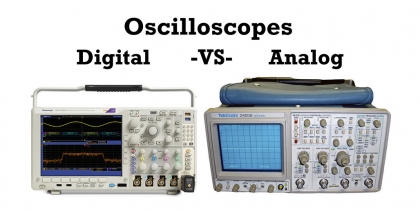
Credit: www.axiomtest.com
Digital Oscilloscope: How It Works
Digital oscilloscopes use analog-to-digital converters (ADCs) to digitize incoming signals. The digital data is then processed, analyzed, and shown on an LCD or LED screen. This allows for extra features such as storage, analysis, and even internet connectivity.
Key Features Of Digital Oscilloscopes
- Signal storage: Can capture, save, and recall waveforms.
- Advanced analysis: Offers measurement tools, math functions, and automated calculations.
- Triggering options: More precise and flexible than analog.
- Lightweight and portable: Most models are compact and easy to carry.
- Display quality: Modern screens show high-resolution waveforms.
Typical Digital Oscilloscope Specifications
- Bandwidth: 50 MHz to 4 GHz (professional models can go higher)
- Sample rate: 1 GS/s to 10 GS/s (giga-samples per second)
- Memory depth: 1 kpts to 2 Mpts (thousands to millions of points)
- Weight: Usually 3–10 lbs
Digital oscilloscopes are common in professional labs and classrooms because of their versatility and features.
Analog Vs Digital Oscilloscope: Head-to-head Comparison
The differences between analog and digital oscilloscopes can be seen in several key areas. Here’s a side-by-side look:
| Feature | Analog Oscilloscope | Digital Oscilloscope |
|---|---|---|
| Display Type | CRT | LCD/LED |
| Waveform Quality | Smooth, continuous | May show steps, depends on sample rate |
| Signal Capture | Real-time only | Can capture and store signals |
| Bandwidth | Up to 500 MHz (rarely 1 GHz) | Up to 4 GHz or more |
| Portability | Heavy, bulky | Lightweight, compact |
| Advanced Functions | Limited | Math, analysis, automated measurements |
| Cost | Usually cheaper (used market) | More expensive, but wide range |
Signal Fidelity And Accuracy
Analog oscilloscopes are famous for their signal fidelity. The CRT shows signals exactly as they are, with no digital errors. This is important for seeing very fast, complex waveforms.
Digital oscilloscopes depend on their sample rate and bandwidth. If the sample rate is low, waveforms might look jagged or miss important details. However, high-end digital models can match or even exceed analog fidelity, especially at high frequencies.
Storage And Analysis
One major advantage of digital oscilloscopes is data storage. You can capture signals and analyze them later. Digital models allow you to:
- Save waveforms to USB or computer
- Use math functions (FFT, addition, subtraction)
- Auto-measure frequency, amplitude, rise time
Analog oscilloscopes do not have these features. They show signals in real time, and once the signal is gone, it cannot be recovered.
Triggering Options
Triggering helps you capture specific events in a signal, such as glitches or pulses. Digital oscilloscopes offer more flexible triggering, including:
- Edge trigger
- Pulse width trigger
- Logic trigger
- Video trigger
Analog oscilloscopes have basic edge triggering. For complex signals, digital models are more reliable.
Practical Use Cases
| Application | Best Oscilloscope Type | Reason |
|---|---|---|
| Audio signal analysis | Analog | Smooth waveforms, easy to interpret |
| High-speed digital signals | Digital | High bandwidth, storage, analysis |
| Basic circuit troubleshooting | Analog | Quick real-time view, simple controls |
| Complex protocol debugging (USB, SPI, etc.) | Digital | Advanced trigger, data decoding |
| Portable field work | Digital | Lightweight, battery powered |
Choosing The Right Oscilloscope
Selecting the right oscilloscope depends on your needs, budget, and experience level. Here are some important factors to consider:
1. Application
- For audio or analog signals, analog oscilloscopes are often preferred.
- For digital electronics, embedded systems, or communication protocols, digital oscilloscopes are better.
2. Budget
- Used analog oscilloscopes are cheaper but may lack support and spare parts.
- Entry-level digital oscilloscopes start around $300, but professional models can cost thousands.
3. Portability
- Analog models are heavy and need a stable workbench.
- Digital models are portable and suitable for fieldwork.
4. Features
- Do you need storage, analysis, or computer connectivity? Choose digital.
- If you prefer simple controls and immediate feedback, analog may be easier.
5. Bandwidth And Sample Rate
- Make sure the oscilloscope’s bandwidth covers your signal’s highest frequency.
- In digital oscilloscopes, sample rate should be at least 5–10 times the signal frequency to avoid aliasing.
Common Buyer Mistakes
- Buying too little bandwidth: Signals may appear distorted or incomplete.
- Ignoring sample rate: In digital oscilloscopes, a low sample rate can hide important details.
- Overpaying for features you will not use: Advanced functions are great, but not always necessary.
- Not checking input voltage limits: Using the wrong probe or voltage can damage the oscilloscope.
- Buying used analog oscilloscopes without checking CRT condition: Replacement parts are often unavailable.
Pros And Cons Of Each Type
Understanding the strengths and weaknesses of both types can help you decide.
Analog Oscilloscope
Pros:
- Immediate, real-time display
- Smooth, natural waveforms
- Lower cost (used market)
- Simple controls
Cons:
- No storage or analysis
- Bulky and heavy
- Limited bandwidth
- No advanced triggers
Digital Oscilloscope
Pros:
- Waveform storage and recall
- Advanced measurement tools
- Portable, lightweight
- High bandwidth and sample rate
- Flexible triggering
Cons:
- Can be expensive
- Waveform may look pixelated at low sample rates
- Learning curve for advanced features
Non-obvious Insights
Many beginners miss the importance of probe quality. A poor probe can degrade signal fidelity in both analog and digital oscilloscopes. Always use probes rated for your oscilloscope’s bandwidth.
Another overlooked detail is update rate. Digital oscilloscopes may show fast-changing signals only occasionally, missing rare glitches. If your work involves rare events, check the oscilloscope’s update rate (how many times per second it refreshes the display).
Real-world Example
A university electronics lab uses both types for teaching. Analog oscilloscopes are used for basic circuit experiments, showing students how signals appear in real time. Digital oscilloscopes are used for advanced projects, like microcontroller debugging and protocol analysis. This setup helps students understand both worlds and prepares them for industry needs.

Credit: www.youtube.com
Summary Table: Analog Vs Digital Oscilloscope
| Type | Main Use | Strength | Weakness |
|---|---|---|---|
| Analog | Basic circuits, audio | Smooth display, simple | No storage, bulky |
| Digital | Digital systems, analysis | Advanced features, portable | Can be expensive |
Frequently Asked Questions
What Is The Main Difference Between Analog And Digital Oscilloscopes?
The main difference is in how they show and process signals. Analog oscilloscopes display signals directly using a CRT, giving a smooth, real-time waveform. Digital oscilloscopes digitize the signal, allowing for storage, analysis, and advanced features, but may show digital steps if the sample rate is low.
Are Analog Oscilloscopes Obsolete?
Analog oscilloscopes are not obsolete. They are still used for teaching and simple tasks where real-time display and smooth waveforms matter. However, digital oscilloscopes are more popular in modern labs because of their advanced features.
Can Digital Oscilloscopes Display All Signals Accurately?
Digital oscilloscopes can display signals accurately if their sample rate and bandwidth are high enough. If these specifications are too low, fast signals or sharp edges may be missed or distorted.
Which Oscilloscope Is Better For Beginners?
For beginners, analog oscilloscopes are easier to use due to simple controls. Digital oscilloscopes offer more features but have a steeper learning curve. However, many modern digital models now have user-friendly interfaces.
How Much Does A Good Oscilloscope Cost?
A good analog oscilloscope (used) can cost $100–$500. Entry-level digital oscilloscopes start at $300–$800. High-end digital models can cost $2,000 or more. Prices depend on bandwidth, features, and brand. For more details on oscilloscope pricing and features, visit Wikipedia.
Choosing between an analog and digital oscilloscope depends on your needs, budget, and the types of signals you work with. Both have their place in electronics, and understanding their differences will help you make the best decision for your projects.
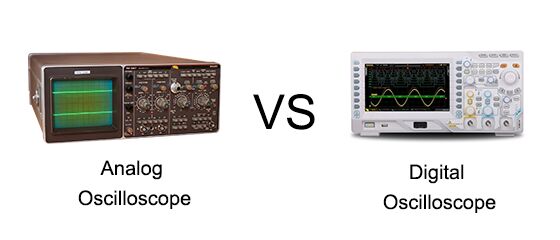
Credit: www.ato.com