Many people working with electronics or electrical circuits often ask: Should I use an oscilloscope or a voltmeter? Both tools measure electricity, but they do very different jobs. Choosing the right one can make your work easier, faster, and more accurate. If you’re a beginner or just curious, this guide will help you understand their differences, strengths, and weaknesses. You’ll also see real examples, practical advice, and some things most newcomers miss.
What Is An Oscilloscope?
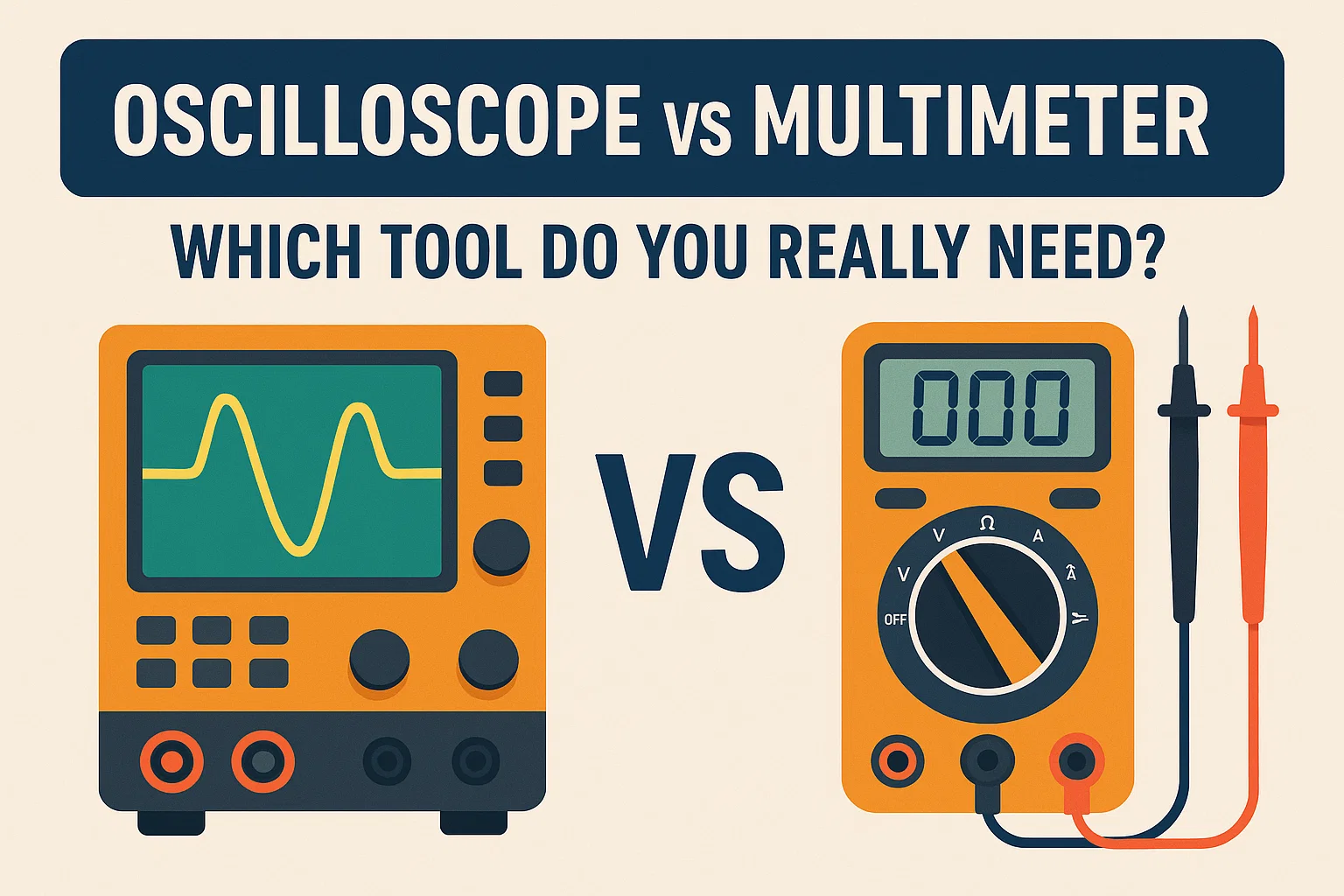
An oscilloscope is a device that shows electrical signals as waves on a screen. You can see how voltage changes over time. This makes it very useful for studying signals that move, change, or repeat—like music, radio waves, or digital data.
Oscilloscopes are common in labs, repair shops, and classrooms. Professionals use them for testing circuits, checking signal quality, or finding faults. A typical oscilloscope lets you see:
- The shape of the voltage signal (waveform)
- How quickly it changes (frequency)
- How strong it is (amplitude)
- If there is noise or distortion
Oscilloscopes can be analog or digital. Digital oscilloscopes are more popular today. They store and process data, making it easier to analyze signals. Some advanced models can save screenshots or connect to computers.
What Is A Voltmeter?
A voltmeter is a simple tool for measuring the amount of voltage between two points in a circuit. You get a single number, like “12.3 volts.” That’s it—no waveforms, no fancy graphics. Voltmeters are much simpler than oscilloscopes, but they’re still essential.
Most voltmeters are digital, and you see the reading on a small screen. Older models use a moving needle. Voltmeter functions are often built into multimeters, which can also measure current and resistance.
Voltmeters are used everywhere—homes, cars, factories, and schools. If you need to check a battery, power supply, or outlet, you’ll probably use a voltmeter.
Key Differences Between Oscilloscope And Voltmeter
Understanding the differences helps you choose the right tool for your job. Here’s a summary in a comparison table:
| Feature | Oscilloscope | Voltmeter |
|---|---|---|
| Displays | Waveforms (graphs) | Numeric value only |
| Measures | Voltage changes over time | Instant voltage at one moment |
| Accuracy | High for dynamic signals | High for steady signals |
| Frequency Analysis | Yes | No |
| Complexity | More complex | Simple |
| Price | Usually expensive | Affordable |
| Common Uses | Signal analysis, troubleshooting | Basic voltage checks |
How Oscilloscopes Work
Oscilloscopes connect to your circuit using probes. When you turn it on, the screen shows a graph with time on the horizontal axis and voltage on the vertical axis. You can see the signal’s shape: is it smooth, jagged, or repeating?
Here’s what happens step-by-step:
- The probe picks up the voltage from your circuit.
- The oscilloscope samples the voltage many times per second.
- It draws the waveform on the screen in real time.
- You can adjust settings like time scale, voltage scale, and trigger level.
Oscilloscopes can show fast and slow changes. They let you “zoom in” to see details or “zoom out” to see long patterns. Some models offer extra features like FFT analysis (shows frequency components) or automatic measurements.
Many beginners miss that oscilloscopes can reveal problems invisible to voltmeters, such as glitches, noise, or irregular spikes. For example, a power supply might look fine on a voltmeter but show nasty spikes on an oscilloscope.

Credit: electronics.stackexchange.com
How Voltmeters Work
Voltmeters are much simpler. You connect two leads (red and black) to the points you want to measure. The meter shows the voltage difference. That’s all.
Digital voltmeters use electronic chips to sample the voltage and display the result. They work well for steady signals like batteries, power supplies, or wall outlets.
Voltmeters do not show changes over time. If the voltage jumps or fluctuates, you might not notice unless you keep watching the screen. For signals that change quickly, a voltmeter can miss important events.
One insight: Some voltmeters can measure average voltage for AC signals, but they may not give the true peak voltage. This can cause confusion if you’re working with audio, radio, or digital circuits.
When Should You Use An Oscilloscope?
Oscilloscopes are the tool of choice when you need to:
- See how signals change over time
- Analyze waveforms (sine, square, triangle, etc.)
- Detect signal noise, glitches, or distortion
- Measure frequency, period, or phase
- Troubleshoot complex electronics
For example, if you’re repairing an amplifier, an oscilloscope can show if the audio signal is distorted. If you’re developing a microcontroller project, you can check if data signals are correct.
Oscilloscopes are essential in:
- Electronics design and testing
- Audio engineering
- Communications (radio, TV, networking)
- Medical devices (ECG, EEG)
- Automotive diagnostics

Credit: thecontentauthority.com
When Should You Use A Voltmeter?
Voltmeters are best for simple tasks:
- Checking battery voltage
- Testing power supplies
- Measuring voltage at outlets or switches
- Confirming circuit connections
If you only need to know “Is there voltage here? ” or “How much voltage is present? ” a voltmeter is perfect. It’s quick, reliable, and easy to use.
Voltmeters are used in:
- Electrical maintenance
- Home repairs
- Automotive work (checking car battery or alternator)
- Industrial equipment checks
Pros And Cons Of Oscilloscopes
Choosing an oscilloscope gives you many advantages, but there are also downsides. Here’s a summary:
| Oscilloscope Pros | Oscilloscope Cons |
|---|---|
| Shows detailed waveforms | Expensive |
| Can measure frequency and timing | Requires training |
| Reveals hidden signal problems | Bulky and not portable |
| Useful for troubleshooting | More settings to adjust |
| Supports advanced analysis | Can be confusing for beginners |
Pros And Cons Of Voltmeters
Voltmeters have their own strengths and weaknesses. Here’s a comparison:
| Voltmeter Pros | Voltmeter Cons |
|---|---|
| Simple to use | Does not show signal shape |
| Affordable | Misses quick changes |
| Portable and lightweight | Limited to steady signals |
| Reliable for basic checks | Cannot analyze frequency |
| Great for beginners | Not useful for complex circuits |
Common Mistakes Beginners Make
- Using a voltmeter for fast-changing signals: If you’re testing audio, digital, or radio signals, a voltmeter can miss important details. Always use an oscilloscope for moving signals.
- Ignoring probe calibration on oscilloscopes: If the probe isn’t calibrated, your measurements can be wrong. Most oscilloscopes have a test point to check calibration—use it before starting.
- Measuring AC with the wrong voltmeter setting: Many voltmeters have separate settings for AC and DC. Using the wrong one can give false readings or damage the meter.
- Not understanding voltage range limits: Both instruments have maximum voltage ratings. Exceeding them can cause damage or safety hazards.
- Assuming all voltmeters measure true RMS: Most cheap meters show average voltage, not “true RMS.” This matters for non-sinusoidal AC signals.
Real-life Example: Diagnosing A Faulty Power Supply
Suppose a device is malfunctioning. You check the output voltage with a voltmeter—it reads 12V. Everything looks fine. But the device still doesn’t work.
You connect an oscilloscope and see spikes and dips in the voltage—these are brief drops and surges. They last only milliseconds, so the voltmeter misses them. The oscilloscope reveals the real problem: the power supply is unstable.
This example shows why oscilloscopes are vital for troubleshooting. They catch issues that voltmeters overlook.
Cost And Accessibility
Oscilloscopes are much more expensive than voltmeters. A basic digital voltmeter costs as little as $20-$50. A decent oscilloscope starts around $300 and can go up to several thousand dollars for advanced models.
Voltmeter:
- Entry-level: $20–$50
- Professional: $100–$200
Oscilloscope:
- Entry-level: $300–$500
- Professional: $1,000–$5,000+
Some online stores and brands offer budget oscilloscopes, but these often lack advanced features or accuracy. For most hobbyists, a voltmeter or multimeter is enough. Engineers and technicians usually invest in oscilloscopes.
For more detailed price comparisons and technical features, you can visit Wikipedia.
Which Is Better For Your Needs?
The answer depends on your tasks:
- If you only need to check voltage levels, a voltmeter is best.
- If you need to study signal shape, timing, or noise, an oscilloscope is essential.
Some people use both—voltmeters for quick checks, oscilloscopes for deep analysis. In electronics labs, technicians often keep both tools handy.
Think about:
- Budget: Oscilloscopes cost more, but offer more information.
- Portability: Voltmeters are small and easy to carry.
- Skill level: Oscilloscopes need more training.
- Type of signal: Steady vs. changing signals.
Practical Tips For Choosing
- Start with a voltmeter if you’re new to electronics. Learn basic voltage checks first.
- If you work with audio, radio, or digital circuits, invest in an oscilloscope.
- Always check the voltage and frequency range of your instruments before buying.
- Look for “true RMS” voltmeters for accurate AC measurements.
- Consider combo devices: Some advanced multimeters include basic oscilloscope functions.
Credit: revinetech.com
Frequently Asked Questions
What Is The Main Difference Between An Oscilloscope And A Voltmeter?
The main difference is that an oscilloscope shows how voltage changes over time (waveforms), while a voltmeter gives a single voltage value at one moment.
Can I Use A Voltmeter To Measure Ac Signals?
Yes, but only for steady AC signals. Voltmeters show the average or RMS voltage, not the shape of the signal. For fast-changing or complex AC signals, use an oscilloscope.
Are Oscilloscopes Difficult To Use For Beginners?
Oscilloscopes have more settings and features. They require some learning, but many modern models are user-friendly. Practice and reading manuals help a lot.
Can A Multimeter Replace An Oscilloscope?
No. Multimeters (including voltmeters) cannot display waveforms or analyze signal timing and frequency. Oscilloscopes are needed for detailed signal analysis.
Is It Safe To Measure High Voltages With These Tools?
Both instruments have voltage limits. Always check the manual for maximum ratings. Use proper probes and safety precautions when measuring high voltages.
Choosing between an oscilloscope and a voltmeter is about knowing your needs. For simple voltage checks, a voltmeter is fast and easy. For analyzing signal behavior, an oscilloscope gives powerful insights. Both tools play important roles in electronics, and learning to use them well opens up new possibilities for testing, troubleshooting, and discovery.