
Oscilloscopes are essential tools for electronics testing, troubleshooting, and research. One important feature that defines their capability is bit resolution. You might have seen oscilloscopes labeled as 8 bit or 12 bit, but what does this mean? How does bit resolution affect performance, accuracy, and real-world usability? Many users assume more bits are always better, but the truth is more nuanced. Let’s explore the differences, strengths, and weaknesses of 8 bit vs 12 bit oscilloscopes in detail.
Understanding Bit Resolution In Oscilloscopes
Every oscilloscope converts analog signals into digital data. The bit resolution tells you how finely the oscilloscope can measure voltage levels. An 8 bit oscilloscope uses an 8 bit ADC (Analog-to-Digital Converter), while a 12 bit oscilloscope uses a 12 bit ADC.
- 8 bit: Can represent 256 (2^8) discrete voltage levels
- 12 bit: Can represent 4096 (2^12) discrete voltage levels
Higher bit resolution means more detail in the digital representation, which affects accuracy, noise, and many other factors.
8 Bit Oscilloscope: Key Features And Performance
Oscilloscopes with 8 bit resolution are common in labs, schools, and industry. They are popular because they are affordable, fast, and easy to use.
1. Voltage Measurement Precision
An 8 bit oscilloscope divides the input voltage range into 256 steps. If your oscilloscope’s vertical range is 8V, each step is 8V / 256 = 31.25 mV. This is enough for many general-purpose tasks, such as measuring digital signals, clock pulses, or rough analog waveforms.
2. Signal Noise And Distortion
With only 256 levels, quantization noise becomes noticeable. Fine details in a signal may be lost, especially for low-amplitude signals. For example, if you are measuring a 0.5V signal, you may see a stair-step pattern rather than a smooth curve.
3. Sampling Rate And Speed
8 bit oscilloscopes often achieve higher sampling rates. This is because the ADC processes fewer bits per sample, so data can move faster. For high-frequency signals (like RF or fast digital circuits), this speed is vital. Many models reach hundreds of megasamples per second (MS/s) or even gigasamples.
4. Cost And Accessibility
These oscilloscopes are usually cheaper. You can find reliable models for under $400. They are widely used in education and basic electronics labs.
5. Common Applications
- Digital signal debugging
- Basic analog waveform viewing
- Microcontroller testing
- Automotive electronics
6. Limitations
- Lower voltage precision
- Limited dynamic range
- Not ideal for audio or sensitive analog measurements
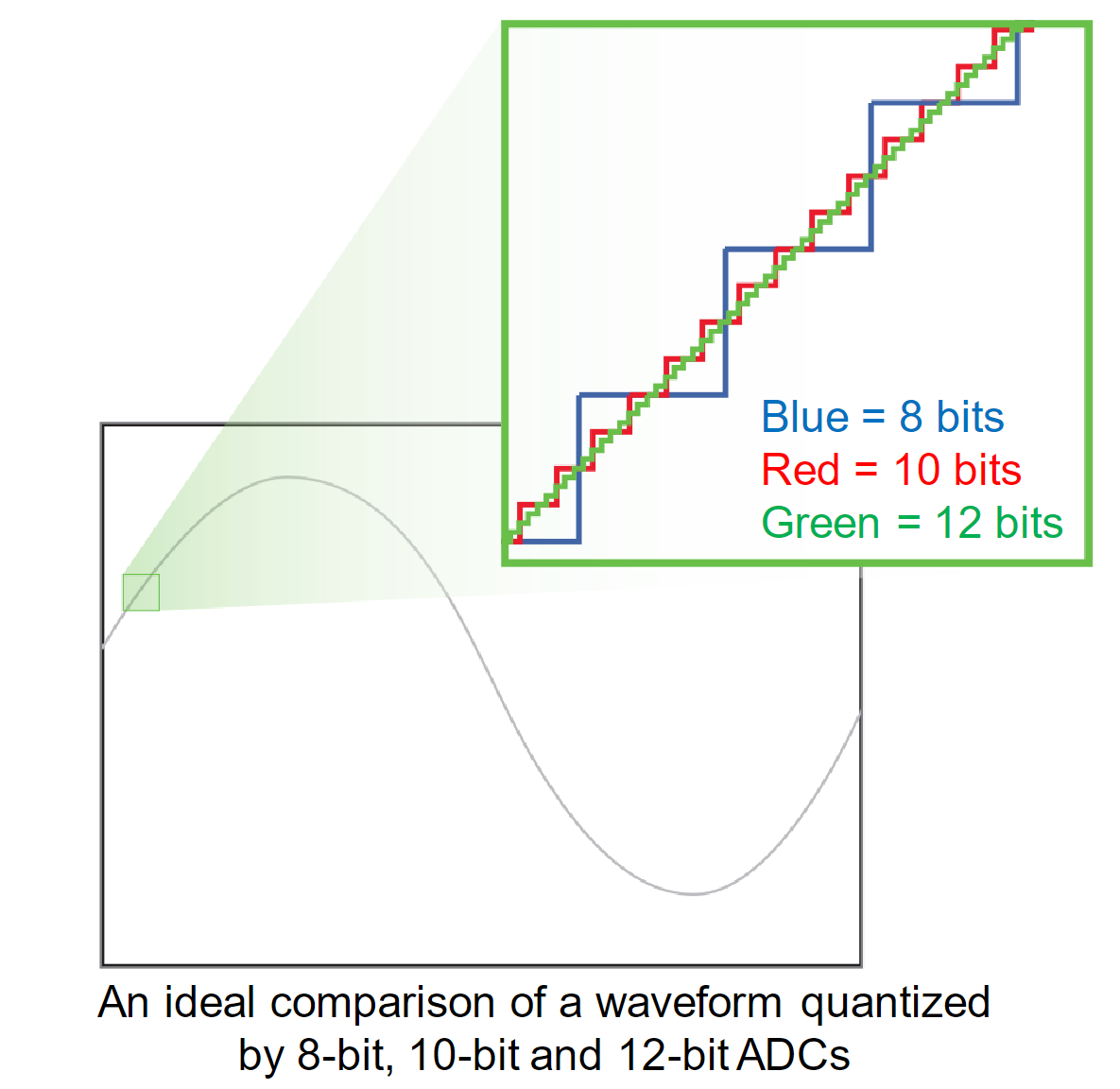
Credit: knowhow.distrelec.com
12 Bit Oscilloscope: Key Features And Performance
Oscilloscopes with 12 bit resolution are designed for higher accuracy and more demanding tasks. They are becoming more popular as ADC technology improves.
1. Voltage Measurement Precision
A 12 bit oscilloscope divides the voltage range into 4096 steps. For an 8V range, each step is 8V / 4096 = 1.95 mV. This is a significant improvement over 8 bit models. Subtle changes and small signals are captured much more accurately.
2. Signal Noise And Distortion
With finer resolution, quantization noise is greatly reduced. You get smoother, cleaner waveforms. This is especially important for analog signals, like audio, sensors, or precision control systems.
3. Sampling Rate And Speed
12 bit ADCs require more processing time per sample. Many 12 bit oscilloscopes have lower maximum sampling rates compared to 8 bit models. However, modern designs can still reach tens to hundreds of MS/s.
4. Cost And Accessibility
They are more expensive. Prices start around $700 and can go much higher. But for users who need precision, the extra investment pays off.
5. Common Applications
- Audio analysis
- Medical electronics
- Sensor testing
- Scientific research
- High-precision analog measurements
6. Limitations
- Higher price
- Lower speed (for some models)
- May require more storage and processing power
Comparing 8 Bit Vs 12 Bit Oscilloscopes: 8 Key Differences
To help you understand the differences, let’s look at the 8 most important factors that separate these oscilloscope types. Each factor is explained in detail below.
1. Voltage Resolution
- 8 bit: 31.25 mV per step (for 8V range)
- 12 bit: 1.95 mV per step (for 8V range)
A 12 bit oscilloscope can detect much smaller voltage changes. This matters when you need to see small variations or weak signals.
2. Dynamic Range
Dynamic range is the span between the smallest and largest signals the oscilloscope can measure accurately. More bits means better dynamic range.
- 8 bit: About 48 dB
- 12 bit: About 72 dB
This difference is crucial for applications where both weak and strong signals are present.
3. Signal Fidelity
Signal fidelity means how closely the oscilloscope shows the real signal. Low bit resolution introduces quantization errors.
- 8 bit: May show “stair-step” artifacts
- 12 bit: Smoother, more accurate curves
For audio and sensor work, this can be the difference between useful data and misleading results.
4. Sampling Rate
8 bit oscilloscopes can often sample faster, because their ADCs are simpler. High-speed digital signals require fast sampling.
- 8 bit: Up to 1 GS/s or more
- 12 bit: Typically up to 200 MS/s (some models higher)
If you need to capture very fast signals, 8 bit models often win in speed.
5. Cost
- 8 bit: $200 – $600 (typical)
- 12 bit: $700 – $3000 (typical)
Budget matters, especially for hobbyists and schools. High-resolution models cost more but deliver greater precision.
6. Application Suitability
- 8 bit: Digital circuits, rough analog signals, general troubleshooting
- 12 bit: Audio, sensors, scientific, medical, precision analog
Choosing the right bit depth depends on your work. For many tasks, 8 bits are enough. For specialized needs, 12 bits are better.
7. Storage And Processing
More bits mean larger data files and more processing power.
- 8 bit: Smaller files, easier to handle
- 12 bit: Larger files, may need faster computers for analysis
This can matter if you record long sessions or need to analyze lots of data.
8. Availability And Market Choices
- 8 bit: Most brands, wide selection, many portable options
- 12 bit: Fewer models, mostly mid-range and high-end
If you want a basic oscilloscope, 8 bit models are everywhere. For 12 bit, you may need to look at specialized brands.
Data Table: 8 Bit Vs 12 Bit Specs
Below is a comparison of typical technical specs for both oscilloscope types.
| Feature | 8 Bit Oscilloscope | 12 Bit Oscilloscope |
|---|---|---|
| Voltage Resolution | ~31.25 mV | ~1.95 mV |
| Dynamic Range | 48 dB | 72 dB |
| Sampling Rate | 100 MS/s – 1 GS/s | 20 MS/s – 200 MS/s |
| Price Range | $200 – $600 | $700 – $3000 |
| Best For | Digital, general purpose | Audio, sensors, research |
Real-world Example: Audio Analysis
Suppose you need to analyze an audio signal from a microphone. The signal ranges from 0. 01V to 1V. An 8 bit oscilloscope’s step size is much larger than many audio signal variations. You may miss subtle details, leading to inaccurate frequency or distortion measurements.
A 12 bit oscilloscope, with its finer step size, captures these variations. You see the real waveform, not just an approximation. For audio engineers, this difference is critical.

Credit: www.researchgate.net
Data Table: Quantization Noise Comparison
Quantization noise is the error caused by rounding analog values to digital steps.
| Bit Depth | Number of Levels | Quantization Noise (dB) |
|---|---|---|
| 8 Bit | 256 | ~48 dB |
| 12 Bit | 4096 | ~72 dB |
Practical Insights And Common Mistakes
Many beginners think higher sampling rate is always better. But if your oscilloscope has low bit resolution, you may see fast but inaccurate results. For analog signals, bit depth is often more important than speed.
Another mistake is to assume that a high bit oscilloscope will always solve accuracy issues. If your signal is noisy or your probe isn’t calibrated, even a 12 bit oscilloscope can give misleading results. Always check your signal quality, probe connection, and oscilloscope settings.
For best results:
- Match bit depth to your application
- Don’t overspend for features you won’t use
- Consider storage and processing needs

Credit: blog.teledynelecroy.com
When Should You Choose Each Type?
If you work mostly with digital signals, such as microcontrollers, logic circuits, or simple electronics, an 8 bit oscilloscope is usually enough. You get fast speed, low cost, and good performance for basic tasks.
If you need to work with analog signals, such as audio, sensors, or scientific measurements, a 12 bit oscilloscope provides the accuracy and fidelity you need. Small voltage changes and subtle signal features are captured clearly.
In some cases, hybrid models offer selectable bit depth, giving you flexibility. Research your options before buying.
For deeper technical information, you can check this Oscilloscope Wikipedia page.
Data Table: Application Suitability
| Application | 8 Bit | 12 Bit |
|---|---|---|
| Digital Signal Debugging | ✔️ | ✔️ |
| Audio Analysis | ❌ | ✔️ |
| Sensor Testing | ❌ | ✔️ |
| Microcontroller Testing | ✔️ | ✔️ |
| Scientific Research | ❌ | ✔️ |
Frequently Asked Questions
What Is Bit Resolution In An Oscilloscope?
Bit resolution is the number of bits used by the oscilloscope’s ADC to convert analog signals into digital data. Higher bit resolution means finer voltage measurements and better accuracy.
Why Is 12 Bit Resolution Better Than 8 Bit?
12 bit resolution allows for smaller voltage steps, greater dynamic range, and reduced quantization noise. It’s better for sensitive analog signals, but may be slower and more expensive.
Can I Use An 8 Bit Oscilloscope For Audio Testing?
Technically yes, but you may miss subtle details in the waveform. For accurate audio analysis, a 12 bit oscilloscope is recommended.
Does A Higher Bit Oscilloscope Require A Faster Computer?
Yes. More bits mean larger data files and more processing. You may need a faster PC for storage and analysis, especially during long recording sessions.
Is Sampling Rate Or Bit Resolution More Important?
For digital signals, sampling rate is often more important. For analog signals, bit resolution is critical. Choose based on your application.
Oscilloscope bit depth is more than just a number—it’s the foundation of measurement accuracy and signal fidelity. By understanding the real differences between 8 bit and 12 bit oscilloscopes, you can make smarter choices for your work, avoid common mistakes, and get the best value for your investment.