When you dive into the world of light measurement, two instruments often appear: the optical spectrum analyzer (OSA) and the spectrometer. To many beginners, they may seem similar. Both are used to study light, both deal with wavelengths, and both are found in labs and industries. But their differences are more than just technical jargon—they affect what data you get, how you use the tool, and even what experiments you can perform. If you’re confused about which one you need, or just curious about how they work, this guide will make things clear. We’ll explore what makes each device unique, where each shines, and share insights that even experienced users sometimes overlook.
What Is An Optical Spectrum Analyzer?
An optical spectrum analyzer is a device designed to measure the intensity of light at different wavelengths, usually in the optical range (visible, near-infrared, and sometimes ultraviolet). It’s a staple in labs that work with lasers, fiber optics, or advanced communication systems.
Unlike simple color meters, an OSA gives you a detailed spectral profile. You can see tiny peaks, dips, and shapes in a light source’s output. This high detail is essential in fields like fiber-optic communications, where engineers need to know exactly which wavelengths are present and how strong they are.
Modern OSAs often use a diffraction grating and a sensitive detector. Light enters the device, is separated into its component wavelengths, and each part is measured. The result is a graph of intensity versus wavelength.
Typical Features Of An Osa
- High wavelength resolution (often down to 0.01 nm)
- Wide wavelength coverage (often 600–1700 nm)
- Ability to analyze weak signals
- Built-in software for peak analysis, bandwidth measurement, and more
Example Use Cases
- Measuring the spectral purity of a laser
- Checking the output of a fiber-optic transmitter
- Diagnosing problems in optical networks
What Is A Spectrometer?
A spectrometer is a broader term. It refers to any device that separates light into its wavelengths and measures some property across those wavelengths. Spectrometers are used in physics, chemistry, biology, astronomy, and more.
Not all spectrometers are designed for the same purpose. Some measure intensity, while others might measure polarization or phase. Some are built for the visible spectrum, others for ultraviolet, infrared, or even X-rays.
Most commonly, a spectrometer consists of three main parts:
- Entrance slit – controls how much light enters
- Dispersive element (like a prism or diffraction grating) – splits light by wavelength
- Detector – measures the light at each wavelength
Spectrometers can be small, handheld devices or large, complex systems. Their resolution, range, and speed vary a lot depending on the application.
Typical Features Of A Spectrometer
- Moderate to high wavelength resolution (0.1–10 nm typical)
- Wide spectral coverage (UV, visible, NIR, or beyond)
- Flexible input: Can measure solids, liquids, or gases
- Adaptable for different kinds of measurements (absorption, emission, reflection, etc.)
Example Use Cases
- Identifying chemical substances by their emission spectra
- Measuring the color of LEDs
- Studying stars and galaxies in astronomy

Credit: www.researchgate.net
Key Differences: Optical Spectrum Analyzer Vs Spectrometer
At first glance, an OSA might seem like a special type of spectrometer. That’s partly true, but there are important differences in how they work and what they’re best used for.
Here’s a direct comparison:
| Feature | Optical Spectrum Analyzer | Spectrometer |
|---|---|---|
| Primary Purpose | Analyze optical signals, especially in telecom and lasers | General analysis of light across many fields |
| Wavelength Resolution | Very high (down to 0.01 nm) | Moderate to high (0.1–10 nm) |
| Wavelength Range | Usually 600–1700 nm (NIR and visible) | Varies: UV, visible, NIR, IR, etc. |
| Signal Strength | Handles weak optical signals well | Depends on the model and detector |
| Analysis Functions | Advanced (bandwidth, OSNR, etc.) | Basic to advanced, depending on software |
| Price | Expensive | Wide range (cheap to expensive) |
Real-world Example
Imagine you’re working with a fiber laser. You want to know if there are any unwanted side peaks or noise in your signal. An OSA will show you even the smallest peaks, letting you fine-tune your laser. A standard spectrometer, unless it’s a high-end model, might miss these fine details.
How Each Device Works
Understanding the inner workings helps you pick the right tool.
Optical Spectrum Analyzer
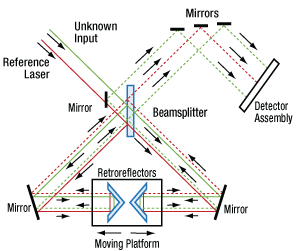
Most OSAs use a diffraction grating and a moving detector. The grating splits incoming light into its wavelengths. The detector moves (or the grating rotates), measuring intensity at each narrow slice of the spectrum.
Some advanced OSAs use Fourier transform methods or arrays of detectors for faster scans.
Spectrometer
A basic spectrometer works similarly, but the detector is often a linear array (like a CCD). Light is split by the grating or prism, and each detector pixel measures a slice of the spectrum at once. This makes many spectrometers faster than OSAs, but with less fine detail.
Some spectrometers use fiber-optic inputs or are integrated into lab instruments for chemical analysis.
Comparison Of Internal Design
| Part | OSA | Spectrometer |
|---|---|---|
| Dispersive Element | High-quality diffraction grating | Prism or grating (varies in quality) |
| Detector | Moving single detector or array | Linear array (CCD, CMOS) |
| Scan Speed | Slower (high precision) | Faster (lower resolution) |
| Calibration | Often auto-calibrated for telecom standards | Manual or auto, depends on field |
When To Use An Optical Spectrum Analyzer
You should choose an OSA when you need:
- Precise wavelength measurement: For example, checking the exact output of a DWDM laser in telecom.
- High dynamic range: OSAs can detect weak signals next to strong ones.
- Detailed spectral analysis: Looking for sidebands, noise, or unwanted peaks.
- Optical communication testing: Measuring OSNR (Optical Signal-to-Noise Ratio), channel spacing, or filter performance.
Many labs use OSAs for R&D in photonics, fiber network monitoring, and laser development. OSAs are also used in the production line for quality control of optical devices.
Non-obvious Insight
OSAs are often optimized for telecom wavelengths (C-band and L-band, around 1550 nm). If you work outside these ranges, check your OSA’s specs carefully. Some users buy OSAs expecting broad coverage, only to find their device can’t measure UV or deep IR signals.
When To Use A Spectrometer
A spectrometer is the better choice when you:
- Need to measure across a wide range of wavelengths (UV, visible, NIR, etc.)
- Want fast measurements (for quality control or handheld use)
- Are doing chemical analysis (absorption, fluorescence, Raman, etc.)
- Need a lower-cost solution for less demanding work
Spectrometers are popular in environmental testing, food safety, art restoration, and even astronomy. Their flexibility makes them a go-to for general light analysis.
Non-obvious Insight
Some spectrometers can be easily customized with different entrance slits, filters, or detectors. This allows you to tune sensitivity and resolution for your specific experiment—something not all OSAs allow.

Credit: www.sciencedirect.com
Key Factors To Consider When Choosing
If you’re deciding between an OSA and a spectrometer, focus on these points:
- Resolution Needs: Do you need to see very fine spectral features? Choose an OSA.
- Speed: For quick scans or real-time monitoring, many spectrometers are faster.
- Budget: OSAs can cost tens of thousands of dollars. Spectrometers start much lower.
- Wavelength Range: OSAs are often limited to telecom bands. Spectrometers can be chosen for UV, visible, IR, or even X-ray.
- Application: Telecom and laser testing usually need an OSA. Chemistry, biology, and general science often use spectrometers.
Common Mistakes
- Assuming all spectrometers can replace OSAs: Many spectrometers lack the detail needed for telecom or laser work.
- Ignoring calibration: Both devices need regular calibration. OSAs often self-calibrate for telecom, while spectrometers may need manual calibration with reference sources.
- Overpaying for unused features: Some people buy high-end OSAs for tasks a simple spectrometer could handle.
Real-world Applications
To see the difference in practice, consider these examples:
- A telecom engineer needs to measure channel spacing in a dense wavelength division multiplexing (DWDM) system. They choose an OSA for its high resolution.
- A food scientist wants to check the color and purity of olive oil. A visible-range spectrometer gives them quick, useful data.
- An astronomer studies the emission lines from a distant galaxy. A spectrometer attached to a telescope reveals the chemical makeup.
- An optical engineer aligns a new laser system. They use an OSA to spot unwanted side modes and noise.
Credit: www.thorlabs.com
Pros And Cons At A Glance
Here’s a quick summary to help you decide:
| Device | Pros | Cons |
|---|---|---|
| Optical Spectrum Analyzer |
|
|
| Spectrometer |
|
|
Frequently Asked Questions
What Is The Main Difference Between An Osa And A Spectrometer?
The main difference is in their resolution and target use. An OSA is designed for high-precision measurements in telecom and laser applications, while a spectrometer is more general-purpose and covers a broader range of wavelengths but often with less detail.
Can A Spectrometer Be Used For Telecom Testing?
Most general spectrometers lack the fine resolution needed for telecom work. For tasks like measuring DWDM channels or OSNR, an OSA is usually required.
Are Osas Always More Expensive Than Spectrometers?
Yes, in most cases, OSAs cost much more due to their precision optics, detectors, and analysis tools. Some high-end spectrometers can also be pricey, but entry-level models are much cheaper.
How Important Is Calibration For These Instruments?
Calibration is critical for both OSAs and spectrometers. Accurate measurements depend on regular calibration with known reference sources. Some OSAs auto-calibrate, while many spectrometers need manual calibration.
Where Can I Learn More About Optical Measurement Devices?
A reliable resource is the Wikipedia page on spectrometers, which covers basics, types, and applications in depth.
Both optical spectrum analyzers and spectrometers are powerful tools, but each has its own strengths. By understanding their differences and real-world uses, you can choose the right one for your needs and get the most value from your measurements.