
The world of electronics and communication is full of specialized tools. Two of the most important are the Vector Network Analyzer (VNA) and the Spectrum Analyzer. They both measure signals, but their roles are very different. If you are involved in RF (radio frequency), microwave engineering, or signal testing, understanding the differences between these instruments is essential.
Imagine you are working with antennas, filters, or amplifiers. You need to know how your device works at different frequencies, how it changes a signal, or if there’s noise or interference in your system. This is where these analyzers come in.
But which one do you really need, and what makes each unique? Let’s dig deep and make sense of their purposes, strengths, and when to use each.
What Is A Vector Network Analyzer?
A Vector Network Analyzer is a powerful instrument for measuring how electrical networks respond to signals. Most commonly, engineers use VNAs to test devices like antennas, filters, cables, and amplifiers. The word “vector” is important: a VNA does not only measure the size (amplitude) of a signal, but also its phase (the timing of the wave).
VNAs work by sending a known signal into a device under test (DUT). They then measure the signal that comes out, comparing it to the original. This tells you how your device changes the signal, both in amplitude and in phase, across a range of frequencies.
Key Features
- Measures both amplitude and phase
- Tests how signals travel through, or reflect from, a device
- Usually used for S-parameters (scattering parameters) like S11 (reflection) and S21 (transmission)
Typical Applications
- Characterizing RF components (filters, antennas, cables)
- Measuring impedance and return loss
- Designing and tuning microwave circuits
VNAs are vital in design and troubleshooting of high-frequency circuits. For example, if you are designing a filter, you want to know exactly which frequencies pass through and which are blocked. A VNA provides a complete picture.
What Is A Spectrum Analyzer?
A Spectrum Analyzer is designed for a different task: measuring the amplitude of signals across a frequency range. It shows you what frequencies are present in a signal and how strong each one is. Spectrum analyzers are widely used in wireless communications, broadcasting, EMC (electromagnetic compatibility) testing, and more.
Unlike VNAs, spectrum analyzers do not measure phase. Instead, they show a graph of power versus frequency, known as a spectrum. This helps you see things like interference, unwanted signals, harmonics, or spurious emissions.
Key Features
- Measures amplitude only
- Displays power versus frequency
- Detects and analyzes signals from the environment or a device
Typical Applications
- Finding unwanted signals (spurious emissions, harmonics)
- Checking if a transmitter meets regulations
- Troubleshooting wireless systems
For example, if you work with radios or Wi-Fi, and you want to see if there’s interference on a certain frequency, a spectrum analyzer is the tool you need.
How Does Each Analyzer Work?
The way these analyzers operate is quite different, and this affects what they can do.
Vector Network Analyzer Operation
A VNA generates a test signal and sends it into a device. It has two or more ports: one for sending the signal, and others for measuring what comes back or passes through. Inside, it uses mixers, reference paths, and digital processing to compare the input and output signals. This way, it can calculate both amplitude and phase differences.
VNAs can measure:
- Reflection (how much signal bounces back)
- Transmission (how much signal passes through)
- Complex impedance (how a device resists or reacts to AC signals)
VNAs often use calibration standards to remove errors from cables or connectors, ensuring accurate results.
Spectrum Analyzer Operation
A spectrum analyzer receives signals from an antenna, cable, or device. It sweeps through a range of frequencies, measuring how much signal power exists at each point. Internally, it uses mixers, filters, and detectors to convert signals to a readable range, then displays the spectrum.
Spectrum analyzers can measure:
- Signal strength at each frequency
- Noise floor (minimum detectable signal)
- Bandwidth of a signal
- Harmonics and spurious signals
Some advanced spectrum analyzers offer real-time analysis, so you can see how signals change over time.
Core Differences: Vna Vs Spectrum Analyzer
To make things clearer, here is a direct comparison of the two instruments:
| Feature | Vector Network Analyzer | Spectrum Analyzer |
|---|---|---|
| Main Measurement | Amplitude & phase (S-parameters) | Amplitude only (power vs. frequency) |
| Typical Use | Component & network analysis | Spectrum monitoring & signal analysis |
| Input Ports | Multiple (usually 2+) | Single |
| Phase Measurement | Yes | No |
| Signal Generation | Built-in source | None |
This table highlights that VNAs are for characterizing how devices affect signals, while spectrum analyzers are for observing the frequency content of signals.
When To Use A Vna Or Spectrum Analyzer
Knowing which instrument to use depends on your task. Here are some common scenarios:
- Designing or Testing RF Components: If you need to know how a filter, antenna, or amplifier works across frequencies, especially both magnitude and phase, use a VNA.
- Checking for Interference: If you want to see all signals present in a given frequency range, or diagnose unexpected signals, use a spectrum analyzer.
- Tuning Circuits: For tasks like matching impedance or adjusting filters, the VNA is essential because it shows both amplitude and phase.
- Regulatory Compliance: Spectrum analyzers help check if transmitters meet legal limits on power, bandwidth, and spurious emissions.
- Field Troubleshooting: Portable spectrum analyzers are widely used to scan for wireless problems, interference, or unauthorized transmissions.
Practical Example: Testing A Wi-fi Antenna
Suppose you are working on a new Wi-Fi antenna. You want to know two things:
- How well the antenna transmits at 2.4 GHz and 5 GHz (main Wi-Fi bands)
- If there is any strong interference in the area
With a VNA, you connect the antenna and measure S11. This tells you how much signal is reflected at different frequencies. A good antenna has low reflection (good matching) at your desired bands.
With a spectrum analyzer, you can scan the 2.4 GHz and 5 GHz bands to see what signals are present. You might find nearby Wi-Fi networks, microwave oven noise, or other sources of interference.
Both tools are useful, but for different parts of the job.

Credit: coppermountaintech.com
Technical Specifications: What To Look For
When choosing a VNA or spectrum analyzer, pay attention to these specifications:
For Vector Network Analyzers
- Frequency Range: Make sure it covers your device’s frequencies.
- Number of Ports: Two-port VNAs are common, but some need four or more.
- Dynamic Range: How well it measures small signals next to big ones.
- Accuracy: Especially phase and magnitude accuracy.
- Calibration Options: Look for easy and reliable calibration.
For Spectrum Analyzers
- Frequency Range: Must cover your signals of interest.
- Resolution Bandwidth (RBW): Determines how finely it distinguishes signals.
- Dynamic Range: Important for seeing weak signals near strong ones.
- Sweep Speed: Fast sweeps help catch short events.
- Display and Storage: Modern analyzers offer advanced displays and data export.
A common mistake is buying an instrument with a limited frequency range. For example, if you want to test 5G devices, you need equipment that goes beyond 6 GHz. Always check specs carefully.
Cost And Accessibility
VNAs and spectrum analyzers range from affordable USB-based models to high-end lab equipment costing tens of thousands of dollars.
- Entry-level VNAs (up to a few GHz) can cost $1,000 to $5,000.
- High-end VNAs (tens of GHz) can exceed $50,000.
- Basic spectrum analyzers start around $1,000, but advanced real-time models can cost $20,000 or more.
Open-source and DIY options exist, but they often lack the accuracy or features needed for professional work. Renting is common for short-term needs.
Limitations And Common Misunderstandings
It’s easy to think that one analyzer can do it all, but that’s not true.
- VNAs cannot show you unknown signals in the environment; they need a known test setup.
- Spectrum analyzers cannot measure phase or S-parameters; they only show power levels.
Another common mistake is connecting a high-power transmitter directly to a VNA or spectrum analyzer without proper attenuation. This can damage the instrument. Always use suitable attenuators and follow manufacturer guidelines.
Some modern instruments combine VNA and spectrum analyzer functions in one box. However, these are often more expensive and may have trade-offs in performance.
Real-world Use Cases
Here are three real-world examples to highlight the difference:
- Telecom Base Station Maintenance: Field engineers use spectrum analyzers to check for interference and signal strength, but use VNAs to test antenna matching and cable loss.
- Filter Manufacturing: Every filter must meet specific transmission and rejection specs. VNAs measure these parameters during production.
- EMC Testing: Spectrum analyzers detect unwanted emissions from electronic products, helping ensure compliance with international standards.
Industry Standards And Calibration
Both VNAs and spectrum analyzers follow strict industry standards for accuracy and calibration. For example, the IEEE and IEC publish guidelines for measurement uncertainty and calibration methods.
Regular calibration is critical. Even small errors can affect results, especially at high frequencies. Most labs calibrate their analyzers yearly or after any repair. Using calibration kits and procedures is essential for reliable measurements.
If you want more details on calibration standards, check the IEEE’s official documentation at IEEE Xplore.
Key Specifications Compared
To help you quickly compare, here is a summary of the most important specs:
| Specification | VNA | Spectrum Analyzer |
|---|---|---|
| Frequency Range | Up to 110 GHz (some models) | Up to 110 GHz (high-end) |
| Dynamic Range | 100–130 dB typical | 80–100 dB typical |
| Phase Measurement | Yes | No |
| Port Count | 2–4 (sometimes more) | 1 |
| Price Range | $1,000 – $100,000+ | $1,000 – $50,000+ |
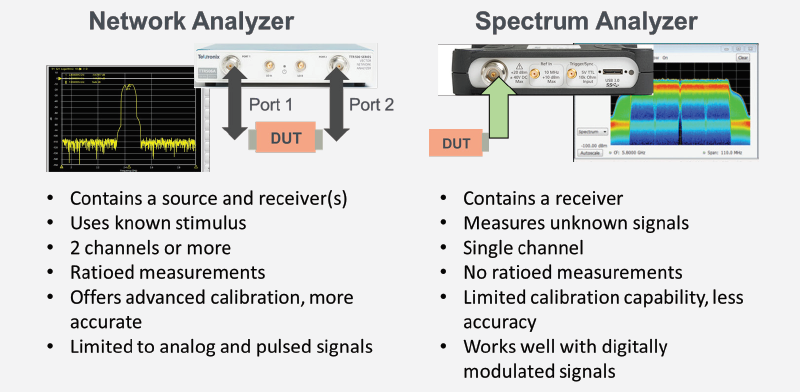
Credit: www.tek.com
Insights Most Beginners Miss
- Phase information is often more important than you think. Many RF issues only show up in phase, not amplitude. For example, poor filter phase response can destroy a communication system, even if amplitude looks good.
- Calibration is not optional. Without proper calibration, both VNAs and spectrum analyzers can give misleading results. Always use calibration kits and follow procedures.
- Impedance matching affects all measurements. If your cables or adapters are not matched, reflections can ruin results. This applies to both analyzers.
- Dynamic range can limit what you see. In crowded frequency environments, a spectrum analyzer with limited dynamic range might miss weak signals near strong ones.
Frequently Asked Questions
What Is The Main Difference Between A Vna And A Spectrum Analyzer?
A VNA measures both amplitude and phase, letting you analyze how devices affect signals (S-parameters). A spectrum analyzer measures only amplitude (power vs. frequency), letting you see what signals are present and their strength.
Can A Spectrum Analyzer Replace A Vna?
No. A spectrum analyzer cannot measure phase or S-parameters. If you need to know how a device changes a signal, especially for RF design, you need a VNA.
Is It Possible To Combine Both Functions In One Instrument?
Some high-end instruments combine VNA and spectrum analyzer functions, but they are more expensive. There can also be compromises in accuracy or features compared to dedicated devices.
Do I Need To Calibrate Both Instruments?
Yes. Calibration is essential for both VNAs and spectrum analyzers to get accurate results. Use proper calibration kits and follow recommended procedures.
Which Should I Buy First: A Vna Or A Spectrum Analyzer?
If you work mainly on RF component design or tuning, start with a VNA. If your work is more about signal monitoring, interference, or regulatory testing, a spectrum analyzer is the better first tool.
Both VNAs and spectrum analyzers are key tools in modern electronics and communications. They do different jobs, and knowing which one to use—and how to use it correctly—will save you time, money, and frustration. With the right analyzer and proper technique, you can solve complex signal problems and design better systems.

Credit: www.allelcoelec.com